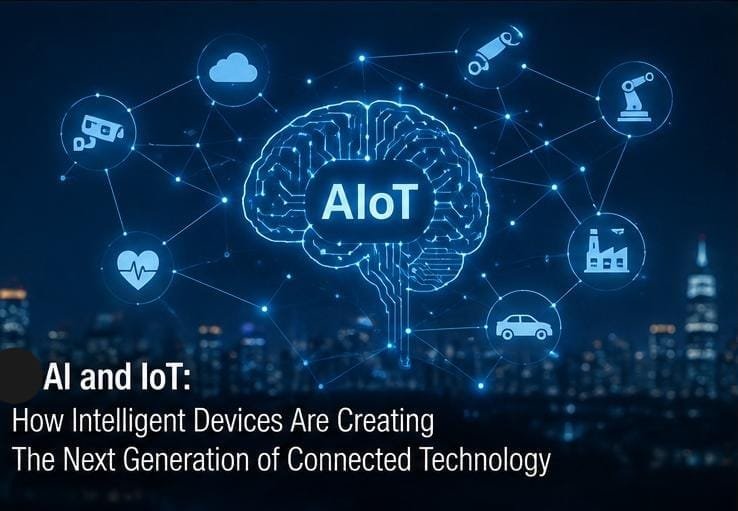
The Internet of Things has traditionally focused on connecting physical devices and collecting information. Sensors measure temperature, cameras capture images, machines report performance, and wearable devices track activity.
But collecting data is only one part of the equation.
The next major step is making connected devices capable of understanding that data and responding intelligently.
This is where artificial intelligence and IoT come together.
The combination is often called AIoT, or Artificial Intelligence of Things. It combines connected sensors and devices with machine learning, computer vision, predictive analytics, and automated decision-making.
Together, AI and IoT can transform devices from passive data collectors into intelligent systems.
Understanding the Difference Between IoT and AIoT
Traditional IoT follows a relatively simple model.
A sensor collects data, sends it through a network, and a software platform analyzes the information.
AI adds another layer.
Instead of simply displaying data, AI can identify patterns, detect anomalies, predict outcomes, and recommend actions.
For example, an IoT temperature sensor might report that a machine is operating at 85 degrees.
An AI-powered system could recognize that this temperature is unusual compared with historical patterns and determine that the machine may be developing a problem.
This makes the system more proactive.
Why AI Makes IoT More Powerful
IoT deployments can generate enormous volumes of data.
A factory containing hundreds of machines could produce measurements every second. A smart city may have traffic sensors, cameras, environmental monitors, parking systems, and energy meters.
Humans cannot manually analyze all of this information in real time.
AI can process large amounts of data and identify relationships that may not be immediately obvious.
This allows IoT systems to move from monitoring toward prediction and automation.
Predictive Intelligence
One of the most useful AIoT applications is prediction.
Connected devices continuously collect information. AI models can use historical and real-time data to identify patterns.
In manufacturing, this can help predict equipment failures.
In transportation, AI can analyze vehicle information to identify maintenance requirements.
In energy systems, algorithms can forecast demand.
In buildings, AI can analyze occupancy and environmental information to optimize heating and cooling.
The common idea is simple: use connected data to anticipate what might happen next.
Edge AI
AI processing does not always need to happen in a distant cloud.
Edge AI places machine-learning capabilities on or near connected devices.
This can be particularly valuable when decisions need to happen quickly.
Imagine an industrial camera inspecting products on a production line. Sending every image to a remote cloud server could introduce unnecessary latency and consume significant bandwidth.
An edge device can process the images locally and send only relevant information to a central system.
This architecture can provide faster responses, reduce data transmission, and improve resilience when connectivity is unreliable.
AIoT in Smart Homes
Smart homes are becoming more intelligent through AI.
A traditional smart thermostat may follow a fixed schedule.
An AI-enabled thermostat could analyze occupancy patterns, temperature preferences, weather conditions, and energy consumption to optimize settings dynamically.
Similarly, smart cameras can use computer vision to distinguish between different types of activity instead of generating alerts for every movement.
This reduces unnecessary notifications and makes connected systems more useful.
AIoT in Healthcare
Healthcare is another area where connected intelligence can provide significant value.
Wearable devices can collect information such as heart rate, movement, sleep patterns, and other measurements.
AI can analyze these streams to identify unusual patterns and provide useful information to healthcare professionals or users, depending on the system.
Remote monitoring can also help support patients outside traditional clinical environments.
However, healthcare IoT requires particularly careful attention to privacy, security, reliability, and regulatory requirements.
AI should support informed decisions rather than be treated as an unquestionable replacement for professional judgment.
AIoT in Transportation
Connected vehicles generate information about location, speed, energy consumption, mechanical condition, and driving behavior.
AI can analyze this information for route optimization, predictive maintenance, traffic management, and fleet efficiency.
Fleet operators can use connected systems to identify inefficient routes, monitor vehicle health, and improve scheduling.
Smart-city infrastructure can also combine information from traffic signals, cameras, road sensors, and transportation systems to improve traffic flow.
AIoT in Agriculture
Agriculture is increasingly becoming data-driven.
IoT sensors can measure soil moisture, temperature, humidity, weather conditions, and other environmental variables.
AI can analyze this information and help farmers make more informed decisions about irrigation, fertilization, crop monitoring, and disease detection.
Instead of applying resources uniformly across an entire field, connected systems can support more targeted approaches.
This can improve efficiency while reducing waste.
AIoT and Energy Management
Energy systems are becoming more complex as renewable generation, batteries, electric vehicles, and distributed energy resources become more common.
IoT provides the data needed to understand energy production and consumption.
AI can analyze that information to forecast demand, identify unusual usage, and coordinate resources.
For businesses, intelligent energy management can help reduce unnecessary consumption.
For smart buildings, AI can coordinate heating, cooling, lighting, and other systems according to occupancy and environmental conditions.
From Cloud-Centric IoT to Edge-Cloud Systems
Modern IoT architecture is increasingly becoming distributed.
Instead of sending everything directly to the cloud, systems can divide responsibilities between devices, edge infrastructure, and centralized platforms.
Devices can perform basic sensing and control.
Edge systems can perform real-time analytics and AI inference.
Cloud platforms can provide long-term storage, large-scale analytics, coordination, and model management.
Recent research describes this as an edge-cloud continuum, where computing resources are intelligently distributed across different levels of the IoT architecture.
The Rise of Autonomous IoT
The ultimate goal of AIoT is not simply better dashboards.
It is increasingly about autonomous action.
An intelligent system might detect a machine anomaly, determine its likely cause, schedule maintenance, notify a technician, and adjust production to reduce disruption.
A smart building could detect changing occupancy patterns and automatically optimize its energy systems.
A logistics platform could identify a delayed shipment and recommend an alternative route.
These systems demonstrate a shift from connected devices toward connected decision-making.
Security Challenges
AIoT also creates new security concerns.
Connected devices already expand an organization’s attack surface. Adding AI introduces additional components such as models, training data, inference systems, and algorithmic decision processes.
Organizations must protect both the physical devices and the intelligence layer.
Secure authentication, encrypted communications, access controls, network segmentation, software updates, and monitoring remain essential.
AI systems also need protection against manipulated or poor-quality data.
If an intelligent system receives incorrect information, its decisions may also be incorrect.
Privacy and Responsible AIoT
AIoT can provide useful automation, but organizations must consider privacy.
Connected cameras, microphones, wearables, vehicles, and environmental sensors can generate information about people and their behavior.
Companies should collect only the information necessary for the intended purpose and provide appropriate controls.
Transparency is also important.
Users should understand when connected systems are collecting information and, where appropriate, how automated decisions are being made.
What Businesses Should Consider
Businesses considering AIoT should start with a specific problem.
Instead of asking, “How can we use AI and IoT?” organizations should ask:
“What decision could become better if we had real-time data and intelligent analysis?”
This approach keeps technology connected to business value.
Organizations should also consider infrastructure, data quality, cybersecurity, integration, cost, and scalability.
A small pilot can demonstrate whether a particular AIoT application provides measurable benefits before a large-scale rollout.
The Future of AIoT
AI and IoT are likely to become increasingly interconnected.
Future devices will not simply sense their surroundings. They will interpret information, learn from patterns, communicate with other systems, and potentially take action.
This will affect homes, factories, vehicles, agriculture, healthcare, logistics, retail, energy, and cities.
The most important change may be that intelligence becomes distributed.
Rather than relying entirely on centralized computing, connected environments will increasingly contain intelligence at multiple levels.
Conclusion
The combination of AI and IoT represents a major evolution in connected technology.
IoT provides the sensing and connectivity layer, while AI provides the ability to interpret information, recognize patterns, predict outcomes, and support decisions.
Edge AI makes this combination even more powerful by bringing intelligence closer to where data is generated.
As AIoT develops, the value of connected technology will increasingly come not from how many devices are connected, but from what those devices can understand and accomplish.
The future of IoT is therefore not simply a world filled with connected things. It is a world where connected things can become increasingly intelligent.