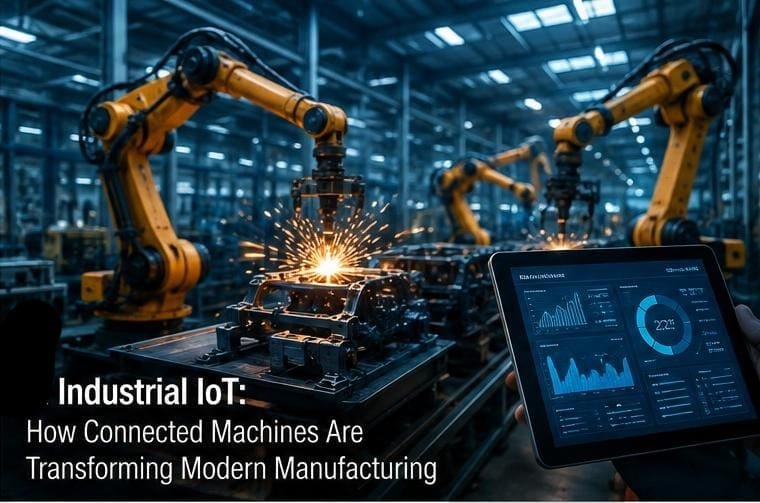
Manufacturing is undergoing a major technological transformation. Factories that once depended primarily on manual inspections, isolated machines, and periodic maintenance are increasingly becoming connected environments where equipment continuously generates and exchanges data.
This transformation is powered by Industrial Internet of Things, commonly called Industrial IoT or IIoT.
Industrial IoT connects machines, sensors, production systems, software, and people. Instead of operating independently, industrial assets can communicate information about their condition and performance.
The result is a manufacturing environment where companies can make decisions based on real-time operational information rather than assumptions or delayed reports.
What Is Industrial IoT?
Industrial IoT is the application of IoT technology to manufacturing, energy, transportation, logistics, utilities, and other industrial environments.
A typical IIoT system may include sensors installed on machines, industrial gateways, communication networks, edge computers, cloud platforms, analytics software, and dashboards.
Sensors can measure variables such as temperature, vibration, pressure, humidity, speed, energy consumption, and machine output.
That information can then be analyzed to identify problems, improve processes, and automate decisions.
Modern manufacturing strategies increasingly treat IoT as a foundation for industrial AI and smart-factory development. Gartner’s 2026 manufacturing research describes IoT as foundational to edge and industrial AI applications.
From Traditional Factories to Smart Factories
Traditional factories often rely on scheduled inspections and preventive maintenance.
For example, a machine might receive maintenance every six months regardless of its actual condition.
IIoT enables condition-based approaches.
Sensors can continuously monitor machine performance and identify changes that may indicate developing problems.
This allows organizations to move toward predictive maintenance, where maintenance activities are planned based on evidence about equipment condition.
The difference can be significant.
Instead of asking, “When is this machine scheduled for maintenance?” managers can ask, “What does the machine’s current data tell us about its condition?”
Predictive Maintenance
Predictive maintenance is one of the strongest applications of IIoT.
Industrial equipment often produces measurable signals before a failure occurs. Increased vibration, abnormal temperature, pressure changes, or unusual energy consumption may indicate a problem.
Connected sensors can capture these signals continuously.
Analytics systems can then compare current measurements with historical patterns and identify anomalies.
When the system detects a potential problem, maintenance teams can investigate before a major failure occurs.
This can reduce unexpected downtime and help companies use maintenance resources more efficiently.
Real-Time Production Monitoring
IIoT can provide managers with a clearer view of production operations.
Connected machines can report production counts, operating times, downtime, energy consumption, and other metrics.
Dashboards can transform this information into operational visibility.
Instead of waiting until the end of a shift for reports, supervisors can monitor production performance while operations are taking place.
This can help identify bottlenecks and respond more quickly to unexpected issues.
Quality Control
Quality control is another important application.
Traditional inspection methods may depend heavily on manual checks. Connected cameras, sensors, and AI systems can supplement those processes.
Machine-vision systems can inspect products for defects while they move through production lines.
When AI is deployed at the edge, image analysis can happen close to the production process. This can be useful where fast decisions are required.
Edge AI is increasingly important in industrial IoT because processing data locally can reduce latency, decrease unnecessary data transmission, and allow systems to continue operating during connectivity problems.
Digital Twins
Digital twins represent another important development in industrial IoT.
A digital twin is a digital representation of a physical machine, production process, building, or system.
Data from connected equipment can continuously update the digital representation.
Manufacturers can use digital twins to study performance, simulate changes, and investigate potential problems.
For example, a factory could model how changing production parameters might affect throughput before implementing those changes on the actual production floor.
This reduces the risk associated with experimentation.
IIoT and Energy Management
Manufacturing consumes significant amounts of energy, making energy monitoring an important IoT application.
Connected meters can measure electricity consumption across machines, production lines, buildings, and facilities.
Analytics can identify unusual consumption patterns.
Companies can then investigate inefficient equipment or processes.
Smart energy management can also support broader sustainability objectives.
Instead of treating energy consumption as a monthly expense, manufacturers can treat it as an operational metric that can be continuously measured and optimized.
The Role of Edge Computing
Cloud computing remains important for industrial IoT, but sending every piece of data to the cloud is not always practical.
Industrial environments can generate enormous quantities of information.
Edge computing allows data processing to happen closer to where the data is generated.
A simplified IIoT architecture might look like this:
Sensors → Machines → Edge Gateway → Cloud Platform → Analytics → Business Systems
The edge layer can filter data, detect anomalies, and perform time-sensitive processing before selected information is sent to the cloud.
This architecture can reduce latency and bandwidth requirements while improving resilience.
5G and Industrial Connectivity
Connectivity is another major part of IIoT.
Different industrial environments require different communication technologies.
Wi-Fi can support many applications. Low-power wide-area networks can support sensors that transmit small amounts of information over long distances. Ethernet remains important in industrial facilities, while private cellular networks can provide controlled wireless connectivity for factories and campuses.
The development of 5G is especially relevant to industrial environments requiring reliable connectivity, mobility, and low latency.
However, organizations should choose connectivity according to actual requirements rather than adopting a technology simply because it is newer.
Cybersecurity in Industrial IoT
Connecting industrial equipment creates enormous opportunities, but it also increases the potential attack surface.
A traditional isolated machine may have had limited network exposure. Once connected, it becomes part of a broader digital environment.
Industrial cybersecurity therefore needs to cover devices, networks, applications, identities, data, and operational technology.
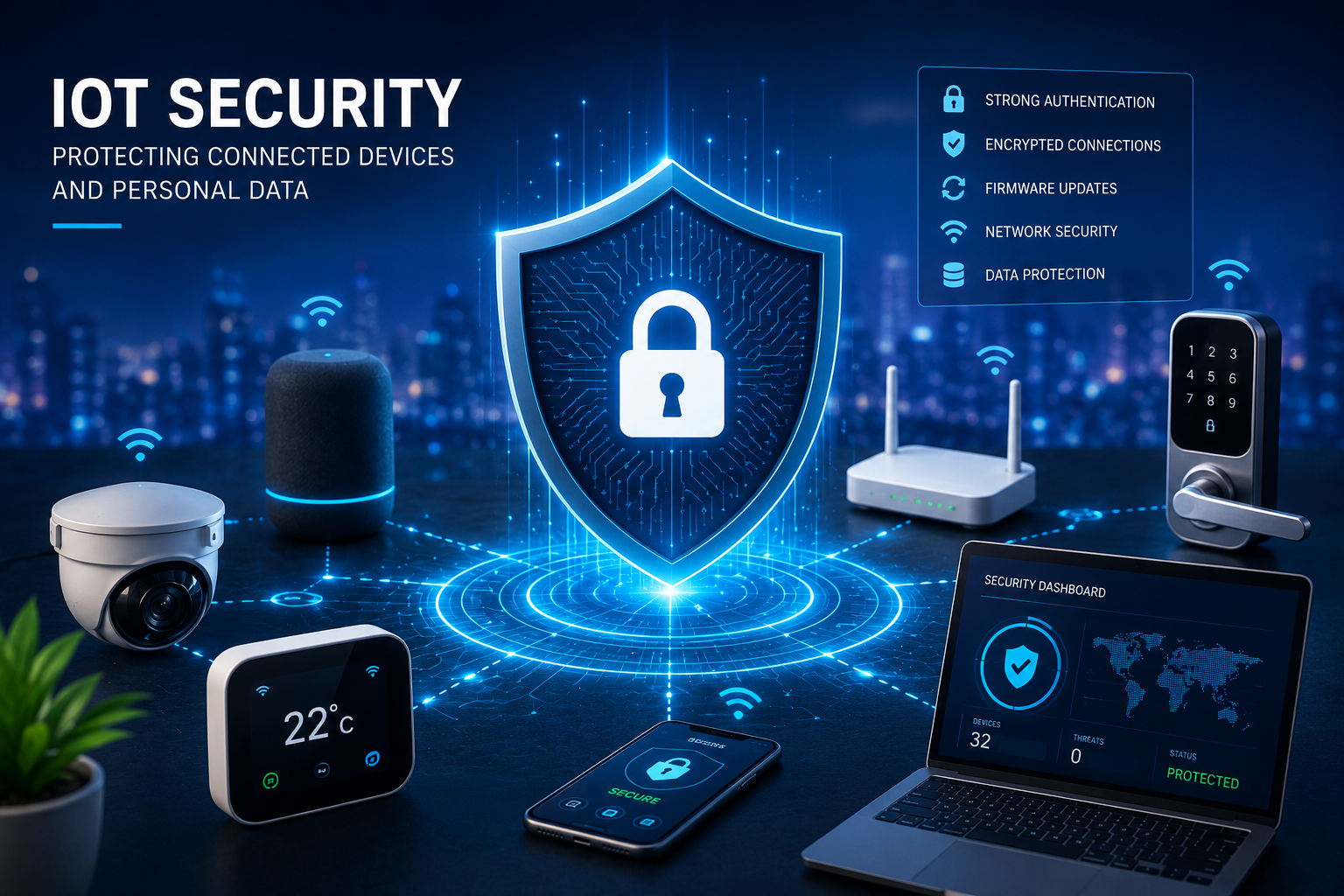
Security measures can include strong authentication, network segmentation, secure device configurations, encryption, monitoring, regular patching, and controlled access.
Security should be considered during system design rather than added after deployment.
Challenges of IIoT Adoption
Industrial IoT projects can be difficult to implement.
Many factories contain legacy equipment that was never designed for modern connectivity. Connecting old machinery may require gateways, adapters, or additional sensors.
Another challenge is data quality.
Collecting millions of measurements does not automatically create value. Companies need reliable data and systems capable of turning that data into useful insights.
Integration is another obstacle.
IIoT systems may need to communicate with manufacturing execution systems, enterprise resource planning software, maintenance systems, and existing operational technology.
Skills are also important. Successful IIoT programs require knowledge across engineering, networking, cybersecurity, data analysis, automation, and software.
How Businesses Should Approach IIoT
Companies should avoid connecting machines simply because IoT technology is available.
A better approach begins with a measurable business problem.
For example:
- Reduce unexpected machine downtime.
- Improve production quality.
- Lower energy consumption.
- Increase asset utilization.
- Improve worker safety.
- Increase supply-chain visibility.
After selecting a goal, the organization can identify which equipment and data are necessary.
Starting with a focused pilot can help companies learn before expanding across an entire facility.
The Future of Industrial IoT
The next phase of IIoT will involve greater integration between IoT, AI, robotics, digital twins, and edge computing.
Machines will increasingly do more than report their condition. They will participate in intelligent systems capable of identifying problems, recommending actions, and in some situations automatically adjusting operations.
This shift is already reflected in the industry’s movement from “sense and transmit” toward systems capable of “sense and decide.”
Factories will become increasingly data-driven, but humans will remain essential.
The role of workers may change from manually monitoring equipment toward supervising automated systems, interpreting insights, solving complex problems, and managing exceptions.
Conclusion
Industrial IoT is transforming manufacturing by connecting machines, sensors, people, and software into intelligent operational systems.
Predictive maintenance, real-time monitoring, quality control, energy management, digital twins, and edge AI are among the technologies helping factories become more efficient and responsive.
However, successful IIoT adoption requires more than installing sensors. Companies need clear objectives, reliable data, secure architectures, appropriate connectivity, and skilled teams.
The smart factory of the future will not simply contain connected machines. It will be an environment where physical operations and digital intelligence work together continuously.