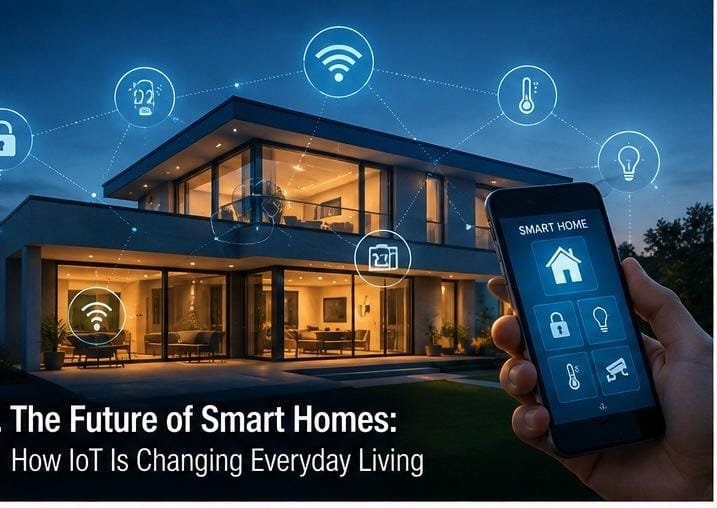
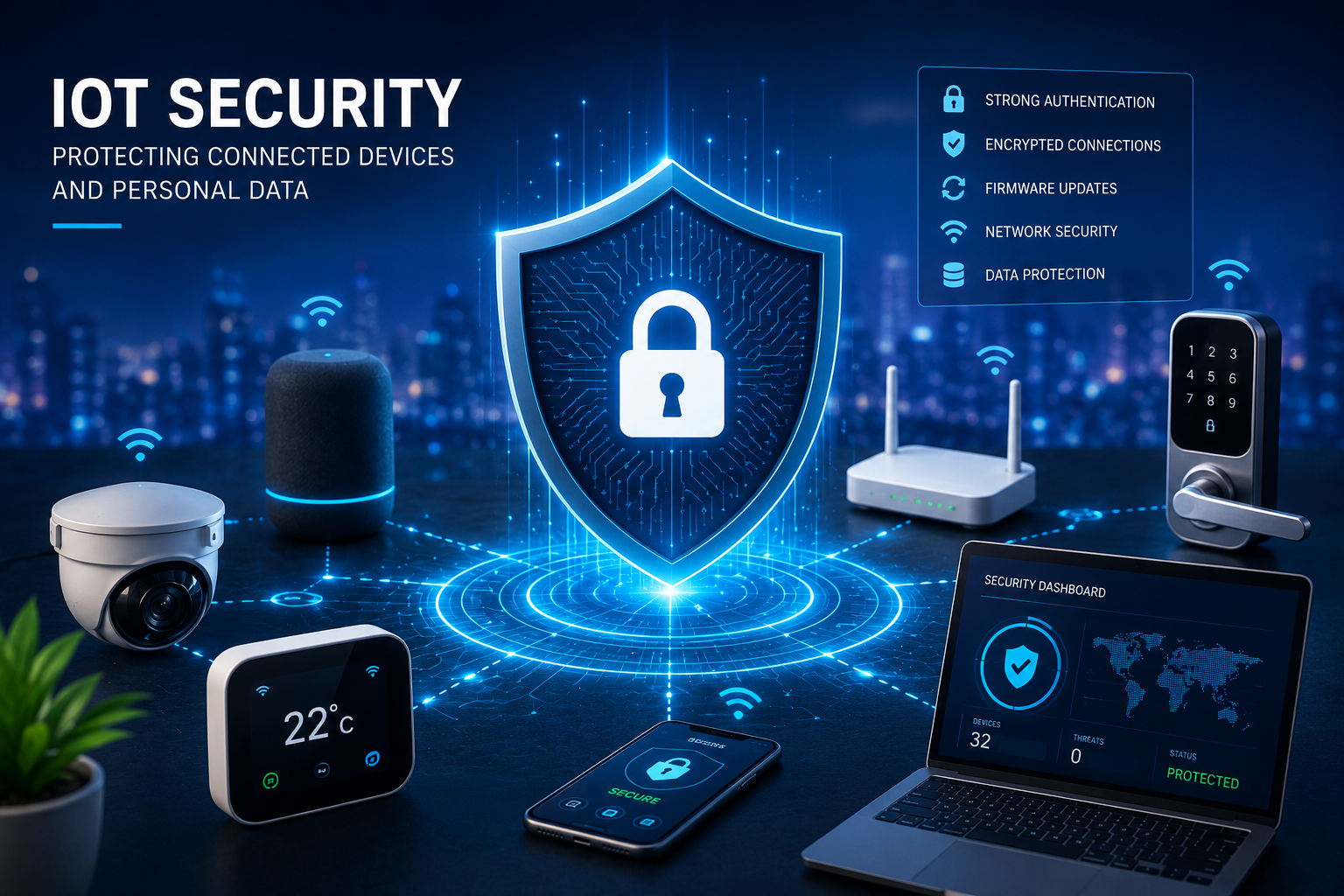
The Internet of Things has made everyday technology more connected than ever. Smart cameras, watches, speakers, appliances, vehicles, industrial machines, sensors, and security systems can communicate over networks and exchange information.
This connectivity creates convenience and new opportunities, but it also creates security risks.
Every connected device can potentially become part of a larger digital attack surface. A poorly secured smart camera or outdated industrial sensor may provide an entry point into a network.
As IoT adoption continues to expand, cybersecurity must become a fundamental part of connected-device design.
What Is IoT Security?
IoT security refers to the technologies, policies, and practices used to protect connected devices, networks, applications, and data.
It covers multiple layers.
These include:
- Device security
- Network security
- Data protection
- Identity and authentication
- Software security
- Cloud security
- Access management
- Monitoring and incident response
Protecting only the device is not enough. IoT systems operate as connected ecosystems, meaning weaknesses in one component can affect others.
Why IoT Security Is Difficult
Traditional computers often have established security tools such as antivirus software, firewalls, and endpoint management systems.
IoT devices can be very different.
Some have limited processing power and memory. Others may run specialized operating systems. Many are designed to operate for years.
Some devices may also be difficult to update.
This creates a challenge for manufacturers and users.
A connected sensor installed in a building might remain in operation for many years. If the manufacturer stops providing security updates, the device can become increasingly difficult to protect.
Default Passwords
Weak or default credentials are among the most basic IoT security problems.
Some devices may initially use common usernames and passwords.
If users fail to change them, attackers may be able to access devices using credentials that are easy to discover.
Strong, unique passwords are therefore essential.
Organizations managing large numbers of devices should also consider centralized identity and credential management rather than relying on manual password changes.
Software Updates
Software vulnerabilities can be discovered after a device has already been deployed.
Security updates are therefore essential.
Consumers should keep smart devices updated whenever manufacturers provide firmware or software patches.
Businesses should maintain an inventory of connected devices so they know which products are deployed, what software versions they use, and whether updates are available.
A device that cannot be updated should be carefully evaluated before being connected to sensitive networks.
Network Segmentation
One important security strategy is network segmentation.
Instead of allowing every IoT device to communicate freely with every other system, organizations can separate devices into appropriate network segments.
For example, smart building sensors could operate on a dedicated network rather than sharing unrestricted access to corporate computers.
If one device is compromised, segmentation can limit the attacker’s ability to move through the network.
This approach becomes especially important in industrial environments where IoT devices may interact with operational technology.
Encryption
Encryption helps protect data while it moves between devices, gateways, applications, and cloud platforms.
Without appropriate protection, sensitive information could potentially be intercepted.
Encryption should be considered across the entire IoT architecture.
Organizations should also protect stored data and carefully manage encryption keys.
Authentication
Authentication ensures that systems can verify who or what is attempting to access a resource.
IoT environments may involve thousands of devices communicating with one another.
It is therefore important to establish device identities and verify those identities before allowing communication.
Strong authentication can reduce the risk of unauthorized access.
For sensitive systems, organizations may also use certificates, hardware-based credentials, or other stronger identity mechanisms.
Secure Device Design
IoT security should begin during product development.
Manufacturers should consider security before devices reach consumers.
Secure development practices can include threat modeling, secure coding, vulnerability testing, protected credentials, secure boot mechanisms, signed firmware, and update mechanisms.
Security-by-design is more effective than attempting to repair fundamental weaknesses after deployment.
Privacy Risks
Security and privacy are closely connected.
Many IoT devices collect information that can reveal personal behavior.
Smart speakers may process voice interactions. Cameras can capture images. Wearables can generate detailed activity information. Smart-home sensors can reveal occupancy patterns.
Organizations should therefore determine what information is genuinely necessary.
Collecting less data can reduce privacy risks.
Users should also understand how information is collected, processed, stored, and shared.
IoT in Business
Businesses face particularly complex IoT security challenges.
A company may have connected devices across offices, warehouses, factories, vehicles, and retail locations.
Some devices may be managed by internal teams, while others may be supplied and maintained by third parties.
This creates visibility challenges.
An organization cannot effectively protect devices it does not know about.
A strong IoT security program should therefore begin with asset discovery and inventory.
Businesses should know what devices are connected, where they are located, what data they handle, who manages them, and what software they use.
Industrial IoT Security
Industrial IoT requires additional caution.
Connected factory machines can affect physical processes.
A cybersecurity incident may therefore cause more than data loss. It could disrupt production, damage equipment, or create safety risks.
Industrial environments often contain legacy equipment that cannot easily be replaced.
Security strategies must therefore account for both modern connected systems and older operational technologies.
Segmentation, monitoring, controlled access, secure gateways, and careful change management can help reduce risk.
Cloud Security
Many IoT systems depend on cloud services.
The cloud may store device information, process data, provide dashboards, and manage device configurations.
This means cloud accounts and APIs become important security components.
Organizations should protect administrative accounts with strong authentication and limit permissions according to actual responsibilities.
APIs should also be secured because they provide communication channels between devices, applications, and cloud services.
Monitoring Connected Devices
Prevention is important, but organizations also need detection.
IoT security systems can monitor device behavior and identify unusual activity.
For example, a sensor that normally communicates with one server may suddenly attempt to connect to many external systems.
That behavior could indicate compromise.
Continuous monitoring allows security teams to investigate suspicious activity earlier.
What Consumers Can Do
Home users can take several practical steps to improve IoT security.
First, change default passwords.
Second, enable two-factor authentication when available.
Third, install firmware and software updates.
Fourth, use a secure Wi-Fi network and keep the router updated.
Fifth, remove devices that are no longer supported.
Sixth, review application permissions and privacy settings.
Finally, avoid connecting unnecessary devices to sensitive networks.
Not every connected gadget needs access to every other device in the home.
What Businesses Can Do
Businesses should take a more structured approach.
They can:
- Create an IoT asset inventory.
- Identify device owners.
- Establish security standards for new devices.
- Segment IoT networks.
- Use strong authentication.
- Maintain patching procedures.
- Monitor device behavior.
- Encrypt sensitive communications.
- Review third-party risks.
- Prepare incident-response plans.
These practices can make IoT deployments more manageable as organizations scale.
The Future of IoT Security
As IoT becomes more intelligent, security will also need to evolve.
AI may help identify unusual device behavior and detect attacks more quickly.
Edge computing may allow some security analysis to happen locally.
Manufacturers will increasingly need to think about security throughout the device lifecycle rather than only at launch.
Regulatory and industry requirements are also encouraging stronger security practices for connected products.
The important principle is that IoT security cannot be treated as a one-time configuration.
Connected systems change over time. Devices receive updates, new vulnerabilities are discovered, networks evolve, and new threats appear.
Security must therefore be continuous.
Conclusion
IoT provides enormous benefits, but connectivity also creates responsibility.
Smart devices must be protected from unauthorized access, software vulnerabilities, data exposure, and network attacks.
Consumers can improve their security by using strong credentials, enabling available security features, updating devices, and carefully managing network access.
Businesses need a more comprehensive strategy involving asset inventories, segmentation, authentication, monitoring, patch management, encryption, and incident response.
The future of IoT will depend not only on connecting more devices but on connecting them responsibly.
A truly smart connected environment is one that provides useful functionality while protecting the people, organizations, and information behind it.