Manufacturing has always evolved alongside technology, but robotics has accelerated that transformation more than almost any previous innovation. From robotic arms assembling vehicles to autonomous machines moving products through warehouses, robots are becoming an essential part of modern industrial operations. They are helping manufacturers improve productivity, maintain consistent quality, reduce workplace risks, and respond to changing customer demands.
The growth of robotics does not simply mean replacing human workers with machines. Instead, modern manufacturing increasingly depends on collaboration between people, robots, artificial intelligence, software, and connected production systems. This combination is creating what is often called the smart factory, where machines can collect information, communicate with other systems, and make increasingly sophisticated decisions.
What Is Robotics in Manufacturing?
Robotics in manufacturing refers to the use of programmable machines to perform industrial tasks with speed, precision, and repeatability. These machines can be designed for simple repetitive activities or complex operations requiring advanced sensors and artificial intelligence.
Industrial robots are commonly used for welding, painting, assembly, packaging, material handling, inspection, cutting, and palletizing. Some machines remain fixed in one location, while mobile robots can move independently around a factory.
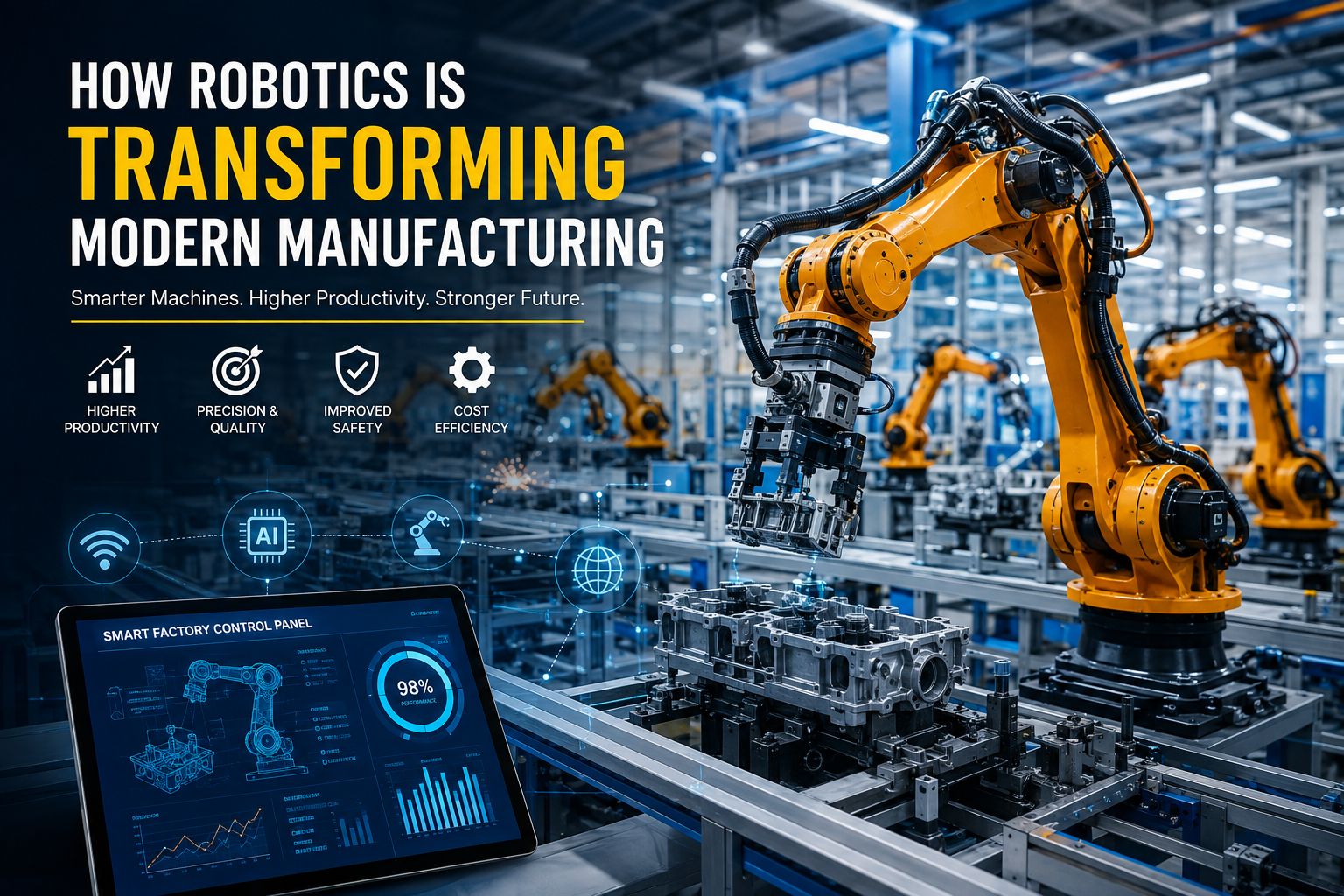
Modern manufacturing robots usually contain several important components. Mechanical arms or moving structures provide physical movement, motors and actuators generate motion, sensors collect information, controllers process commands, and software determines how the machine should behave.
Robotic Arms and Automated Assembly
One of the most visible applications of robotics is the robotic arm. These machines can perform precise movements repeatedly without becoming tired or losing concentration.
Automated assembly systems are particularly useful when products contain hundreds or thousands of components. A robot can pick up a component, position it accurately, attach it, and repeat the process thousands of times.
Automated assembly can improve production consistency because every cycle follows programmed instructions. Manufacturers can also change the software to accommodate new products or production requirements.
Robotics Improves Manufacturing Productivity
One major advantage of robotics is increased productivity. Robots can operate continuously for long periods, including overnight or during scheduled production downtime.
A robot may perform the same movement thousands of times with consistent timing. This can help manufacturers increase production volumes without requiring proportional increases in manual labor.
Robotics can also reduce production bottlenecks. If a particular manufacturing stage is slower than others, automation can help increase its throughput and keep the rest of the production line operating efficiently.
However, productivity improvements depend on proper implementation. Simply purchasing robots does not automatically create a more efficient factory. Companies must analyze workflows, train employees, maintain equipment, and integrate robots with existing systems.
Better Quality and Precision
Manufacturing often requires extremely consistent results. Small variations in assembly, welding, cutting, or packaging can affect product quality.
Robots can execute programmed movements with high repeatability. This makes them valuable for tasks where precision is critical.
Robotic inspection systems are also becoming increasingly sophisticated. Cameras, sensors, machine vision, and artificial intelligence can inspect products for defects. A vision system may identify scratches, incorrect positioning, missing components, or dimensional problems much faster than traditional manual inspection.
This does not eliminate the need for human quality specialists. Instead, robots can perform initial inspections while people focus on complicated defects and quality-management decisions.
Collaborative Robots
Collaborative robots, often called cobots, are designed to work more closely with human employees than traditional industrial robots.
Traditional industrial robots often operate inside protected areas because their high speed and force can create safety risks. Cobots can incorporate sensors and safety systems that allow them to slow down or stop when people enter their working areas, depending on the application and risk assessment.
Cobots can assist employees with lifting, repetitive assembly, packaging, machine tending, and other tasks.
Their relatively flexible deployment makes them attractive to small and medium-sized manufacturers that may not have the resources required for large automated production systems.
Robotics and Workplace Safety
Industrial environments can expose workers to heat, chemicals, heavy objects, sharp tools, repetitive movements, and other hazards.
Robots can take on dangerous tasks, reducing direct human exposure. For example, automated systems can handle materials in hazardous environments or perform repetitive operations that may contribute to physical strain.
Safety, however, remains an important consideration. Robots themselves can create risks if improperly installed, programmed, or maintained. Manufacturers must therefore use appropriate guarding, sensors, emergency stops, training, and safety procedures.
Robotics in Warehouses and Logistics
Manufacturing automation increasingly extends beyond the production line.
Once products are manufactured, they need to be stored, sorted, packaged, and transported. Autonomous mobile robots can move materials between different areas of warehouses and factories.
Automated storage and retrieval systems can also organize inventory and retrieve products with minimal manual movement.
This can make warehouses more efficient, especially when combined with inventory-management software. Robots can receive instructions digitally, locate products, transport them, and report their activities to centralized systems.
Artificial Intelligence Makes Robots Smarter
Traditional industrial robots generally follow predetermined instructions. Modern robotics is becoming more intelligent because of advances in artificial intelligence.
AI-powered systems can analyze sensor information, recognize objects, detect anomalies, and adapt to changing conditions.
Machine vision is an especially important technology. Cameras combined with AI can help robots recognize different objects, identify their positions, and determine how to manipulate them.
AI can also contribute to predictive maintenance. Instead of waiting for a machine to fail, software can analyze vibration, temperature, operating cycles, and other information to identify signs of potential problems.
The Role of Humans in Robotic Factories
A common misconception is that increased automation means humans will no longer be necessary. In reality, robotics changes the types of skills manufacturers need.
Employees may increasingly work as robot operators, technicians, programmers, engineers, data analysts, maintenance specialists, and automation managers.
Workers also remain important for problem-solving, product design, process improvement, supervision, and decisions that require judgment.
As robotics expands, workforce training becomes essential. Companies that invest in employee development can make the transition to automation more effective.
Challenges of Manufacturing Robotics
Despite its benefits, robotics presents several challenges.
The initial investment can be significant. Companies may need to purchase robots, software, sensors, safety systems, integration services, and supporting infrastructure.
Maintenance is another consideration. Robots contain mechanical, electrical, and software components that require regular attention.
Cybersecurity is becoming increasingly important as factories connect robots to networks and cloud platforms. A connected industrial system can potentially become a target for cyberattacks.
There are also workforce concerns. Employees may worry about job displacement or changes to their roles. Transparent communication, retraining, and opportunities to develop new skills can help address these concerns.
The Future of Manufacturing Robotics
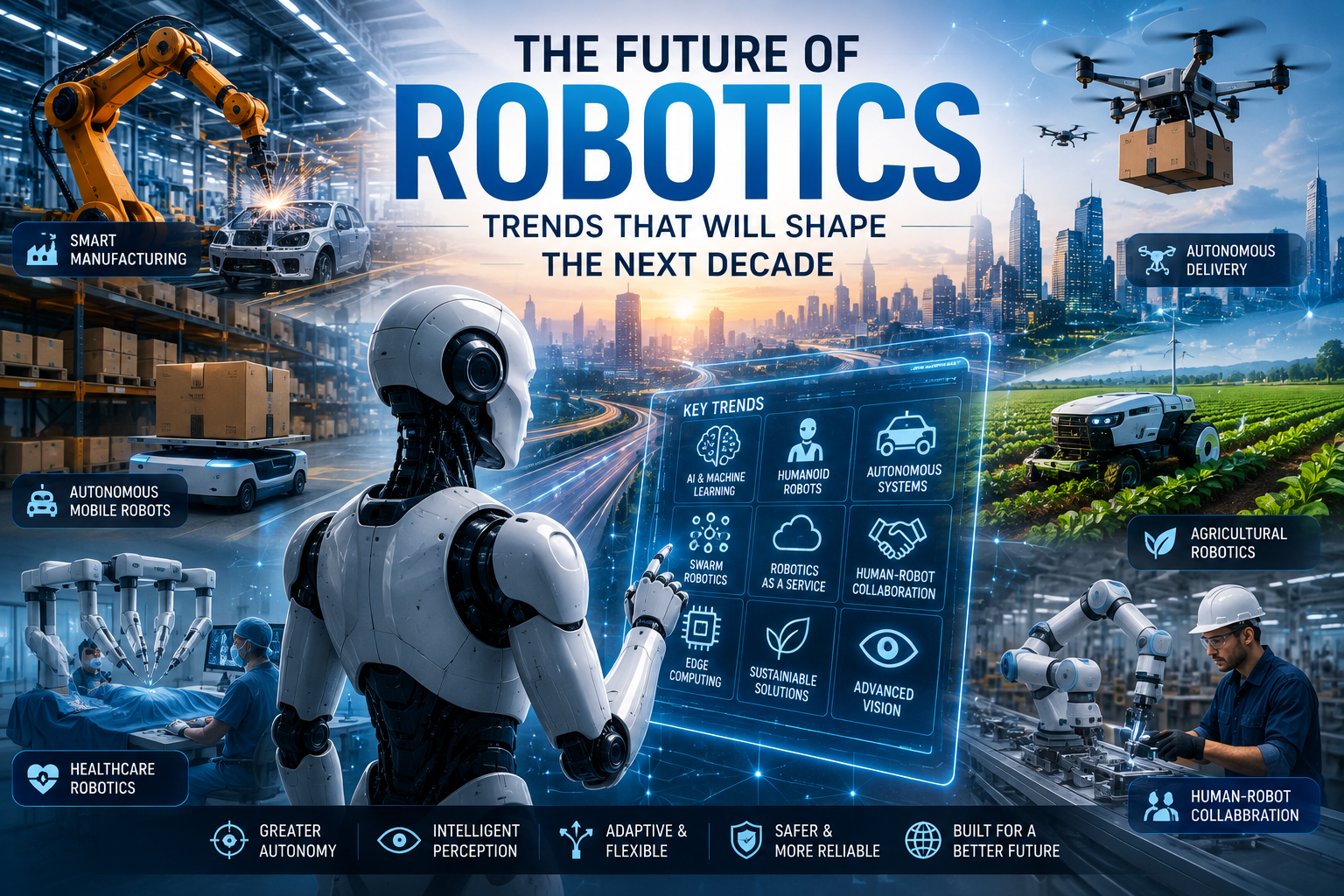
The future of industrial robotics will likely involve greater connectivity, intelligence, flexibility, and collaboration.
Factories may increasingly use fleets of autonomous machines rather than isolated robots. Digital twins could allow manufacturers to simulate production processes before making physical changes. AI could help robots learn from data and adapt to new environments.
Robots may also become easier to program. Instead of requiring specialized programming for every task, workers could potentially teach machines through demonstrations or natural-language instructions.
The result will not simply be factories filled with machines. The future is more likely to be a connected production environment where humans, robots, AI, sensors, and software work together.
Conclusion
Robotics is transforming manufacturing by improving productivity, consistency, safety, flexibility, and operational efficiency. Industrial robots, cobots, autonomous mobile systems, machine vision, and AI are changing how products are manufactured and moved.
The most successful manufacturers will not necessarily be those that automate everything. They will be those that understand which processes benefit most from automation while maintaining strong human expertise.
Robotics is therefore not just a manufacturing technology. It is becoming a foundation of the modern industrial economy, creating new opportunities for companies and workers prepared to adapt to an increasingly automated world.