Blockchain technology has evolved significantly since it first gained widespread attention through cryptocurrency. What began primarily as a system for recording digital currency transactions is now being explored for financial services, digital ownership, supply chains, identity management, gaming, business operations, and decentralized applications.
The future of blockchain is unlikely to depend on cryptocurrency alone. Instead, the technology is gradually becoming part of a broader digital infrastructure in which assets, agreements, credentials, and transactions can be represented and transferred digitally.
As blockchain networks become more scalable and interconnected, several trends could influence how businesses and individuals interact with digital services. Some developments may become mainstream, while others may remain specialized. Understanding these trends provides useful insight into where blockchain technology could be heading.
Blockchain Is Moving Toward Practical Applications
Early discussions about blockchain often focused on its ability to challenge traditional financial systems. Today, organizations are increasingly interested in practical applications that solve specific business problems.
Companies are exploring blockchain for areas such as transaction settlement, supply-chain tracking, digital credentials, asset management, and automated workflows.
This shift is important because long-term adoption will depend on measurable benefits. Businesses generally need technology to reduce costs, improve efficiency, increase transparency, strengthen security, or create new sources of revenue.
Future blockchain development is therefore likely to focus less on using blockchain simply because it is innovative and more on determining where distributed technology provides genuine value.
Greater Blockchain Interoperability
One of the biggest challenges facing blockchain adoption is fragmentation.
There are many blockchain networks, each with different technical architectures, standards, applications, and communities. If these networks cannot communicate effectively, users and businesses may face unnecessary limitations.
Interoperability aims to make different blockchain networks work together more efficiently.
Improved interoperability could allow digital assets and information to move between compatible networks while reducing dependence on isolated ecosystems.
For businesses, this could be particularly valuable. An organization might use one blockchain for supply-chain information and another system for digital payments or tokenized assets. Better interoperability could allow these environments to interact without requiring completely separate workflows.
However, connecting different networks introduces security challenges. Cross-chain systems and bridges must be carefully designed because weaknesses in these connections can create significant risks.
Tokenization of Real-World Assets
Tokenization is another trend that could significantly influence the future of blockchain.
Tokenization involves representing ownership, rights, or interests associated with an asset through digital tokens. Depending on the legal and technical structure, tokenization could be applied to financial assets, real estate, commodities, intellectual property, collectibles, or other forms of value.
One potential advantage is greater flexibility in how assets are transferred and managed.
For example, a traditionally complex asset-management process could potentially use blockchain-based tokens to record transactions and automate certain administrative functions.
Tokenization could also support fractional ownership in some applications, allowing an asset to be divided into smaller digital interests where laws and market structures permit it.
However, tokenization does not automatically create legal ownership. Regulatory frameworks, custody arrangements, investor protections, and enforceable rights remain essential.
The Growth of Decentralized Applications
Decentralized applications, often called dApps, use blockchain networks to support various functions without relying entirely on a traditional centralized backend.
Financial applications are among the best-known examples, but decentralized applications can potentially support gaming, social platforms, marketplaces, identity services, and digital communities.
Future dApps may become easier to use as blockchain infrastructure improves.
User experience has historically been a barrier to adoption. Complicated wallet interfaces, transaction fees, network selection, and security procedures can discourage newcomers.
Developers are increasingly likely to focus on hiding unnecessary technical complexity while retaining the benefits of blockchain underneath the application.
If blockchain applications become as simple to use as conventional digital services, broader adoption could become more realistic.
Blockchain and Digital Identity
Digital identity could become another important area of blockchain development.
People interact with numerous organizations online and frequently need to prove their identity, qualifications, age, ownership, or authorization.
Traditional identity systems often require users to repeatedly provide the same information to different organizations.
Blockchain-based identity solutions could support verifiable digital credentials. An individual could receive a digitally signed credential from a trusted organization and present it to another organization for verification.
This could be useful for educational certificates, professional qualifications, membership credentials, and other forms of verification.
Privacy will be an important consideration. Future identity systems will need to provide users with greater control over what information they reveal and to whom.
Blockchain in Supply Chain Management
Global supply chains are becoming increasingly complex. Businesses need to track products, shipments, certifications, suppliers, and compliance information across multiple organizations.
Blockchain could provide a shared record of important supply-chain events.
Future systems may combine blockchain with sensors, Internet of Things devices, artificial intelligence, and cloud platforms.
For example, a sensor could record environmental conditions during transportation, while a blockchain system could preserve relevant records for authorized participants.
This could make supply chains more transparent and easier to audit.
The major challenge is ensuring that data entering the blockchain is accurate. Blockchain can preserve information reliably, but it cannot independently verify whether a physical-world measurement or manually entered record is truthful.
The Evolution of Enterprise Blockchain
Enterprise blockchain is likely to remain an important area of development.
Companies may use permissioned networks where participants are known and access can be controlled.
These networks can be designed for specific business relationships involving suppliers, financial institutions, logistics companies, government organizations, or other partners.
Instead of replacing existing enterprise systems, blockchain may increasingly operate alongside them.
Future enterprise platforms could combine traditional databases, cloud computing, artificial intelligence, APIs, and blockchain-based ledgers.
This hybrid approach may be more practical than expecting organizations to move their entire operations onto a blockchain.
Blockchain and Artificial Intelligence
Artificial intelligence and blockchain represent two major technology trends that could increasingly interact.
AI systems require data, while blockchain can provide mechanisms for recording and verifying certain types of information.
Blockchain could potentially help establish provenance for digital content or datasets, while AI could assist with analyzing blockchain activity and identifying unusual patterns.
AI may also help blockchain developers create more sophisticated applications, test smart contracts, analyze transactions, and automate certain operational processes.
At the same time, the combination introduces new risks. AI-generated code may contain vulnerabilities, and blockchain-based systems may preserve incorrect information if AI-generated data is not properly verified.
The value of combining the technologies will depend on careful system design rather than simply integrating them because both are popular.
Improvements in Scalability
Scalability has long been a major challenge for blockchain networks.
A system designed to support millions of users needs to process large numbers of transactions efficiently while maintaining appropriate security and decentralization.
Blockchain developers are working on different approaches to improve transaction capacity and reduce costs.
Layered architectures, rollups, sidechains, alternative consensus mechanisms, and other scaling approaches can help networks handle additional activity.
As infrastructure improves, blockchain applications may become more practical for everyday business and consumer use.
Lower transaction costs and faster confirmation times could be particularly important for applications involving frequent, low-value transactions.
Regulation Will Shape Adoption
Regulation will play an important role in determining how blockchain develops.
Governments around the world are examining digital assets, tokenization, financial applications, consumer protection, taxation, cybersecurity, and data privacy.
Clearer regulations could provide businesses with greater confidence when investing in blockchain infrastructure.
At the same time, compliance requirements may influence how blockchain applications are designed.
Future blockchain businesses may need to combine decentralized technology with identity verification, reporting procedures, consumer protections, and other regulatory controls.
The result may be a more mature industry where innovation and compliance develop alongside each other.
Energy Efficiency and Sustainable Blockchain
Environmental concerns have influenced discussions about blockchain, particularly regarding networks that use energy-intensive consensus mechanisms.
As sustainability becomes increasingly important to businesses and consumers, blockchain developers are likely to continue exploring more energy-efficient approaches.
Networks using alternative consensus mechanisms can reduce the computational requirements associated with certain blockchain architectures.
Future blockchain infrastructure will likely be evaluated not only on speed and security but also on energy consumption, operating costs, and environmental impact.
The Rise of Programmable Digital Ownership
Blockchain can introduce a new concept of programmable ownership.
Traditional ownership records generally describe who owns an asset, while blockchain-based assets can potentially include rules governing how they are transferred or used.
A digital ticket, membership credential, collectible, or financial instrument could have programmed characteristics that interact with other applications.
This could create new digital business models.
For example, companies could issue blockchain-based memberships that provide access to services across multiple compatible platforms. Digital assets could potentially carry specific permissions or benefits that change according to predefined conditions.
The challenge will be creating systems that are easy to understand and legally meaningful.
Security Will Remain a Priority
As blockchain adoption grows, security will become even more important.
Blockchain networks may have strong underlying security properties, but applications built on top of them can still contain vulnerabilities.
Smart contracts, wallets, bridges, decentralized applications, exchanges, and user interfaces all represent potential attack surfaces.
Future development will likely place greater emphasis on secure coding, automated testing, independent audits, formal verification, better wallet protection, and improved user education.
Security will be essential for building long-term trust in blockchain applications.
What the Blockchain Economy Could Look Like
The future digital economy may contain a mixture of centralized and decentralized systems.
Traditional banks may continue to exist while using blockchain for settlement or tokenized assets. Businesses may continue using conventional databases while blockchain provides shared records between organizations.
Consumers may use blockchain-based credentials or digital assets without necessarily realizing that blockchain technology is operating in the background.
This could be one of the most important signs of maturity: blockchain may become infrastructure rather than a product that users consciously interact with.
Conclusion
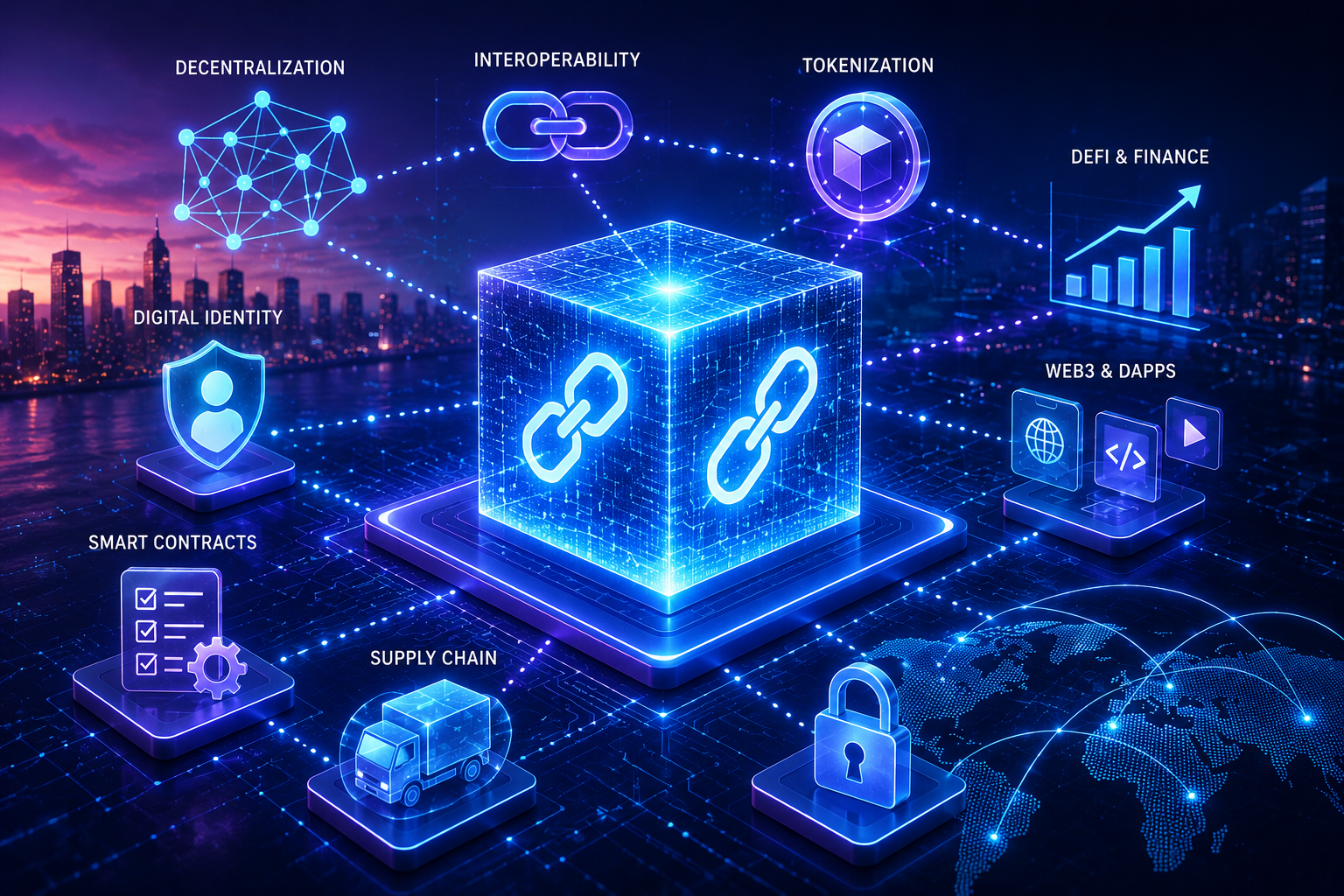
The future of blockchain is likely to be shaped by practical innovation rather than speculation alone. Interoperability, tokenization, decentralized applications, digital identity, enterprise adoption, artificial intelligence integration, scalability, regulation, and security are among the trends that could influence the technology’s next phase.
Blockchain will not necessarily replace traditional databases, financial institutions, or centralized platforms. Instead, it may become another layer of digital infrastructure that organizations use when shared verification, programmable ownership, or decentralized coordination provides a meaningful advantage.
The most successful blockchain projects will likely be those that solve real problems while providing strong security, usability, compliance, and economic value.
As the technology continues to mature, the biggest change may be that blockchain becomes less visible. Instead of being the focus of an application, it could quietly operate behind digital transactions, credentials, assets, and business processes.
That transition from a highly discussed emerging technology to practical digital infrastructure could ultimately define the next stage of blockchain’s evolution.