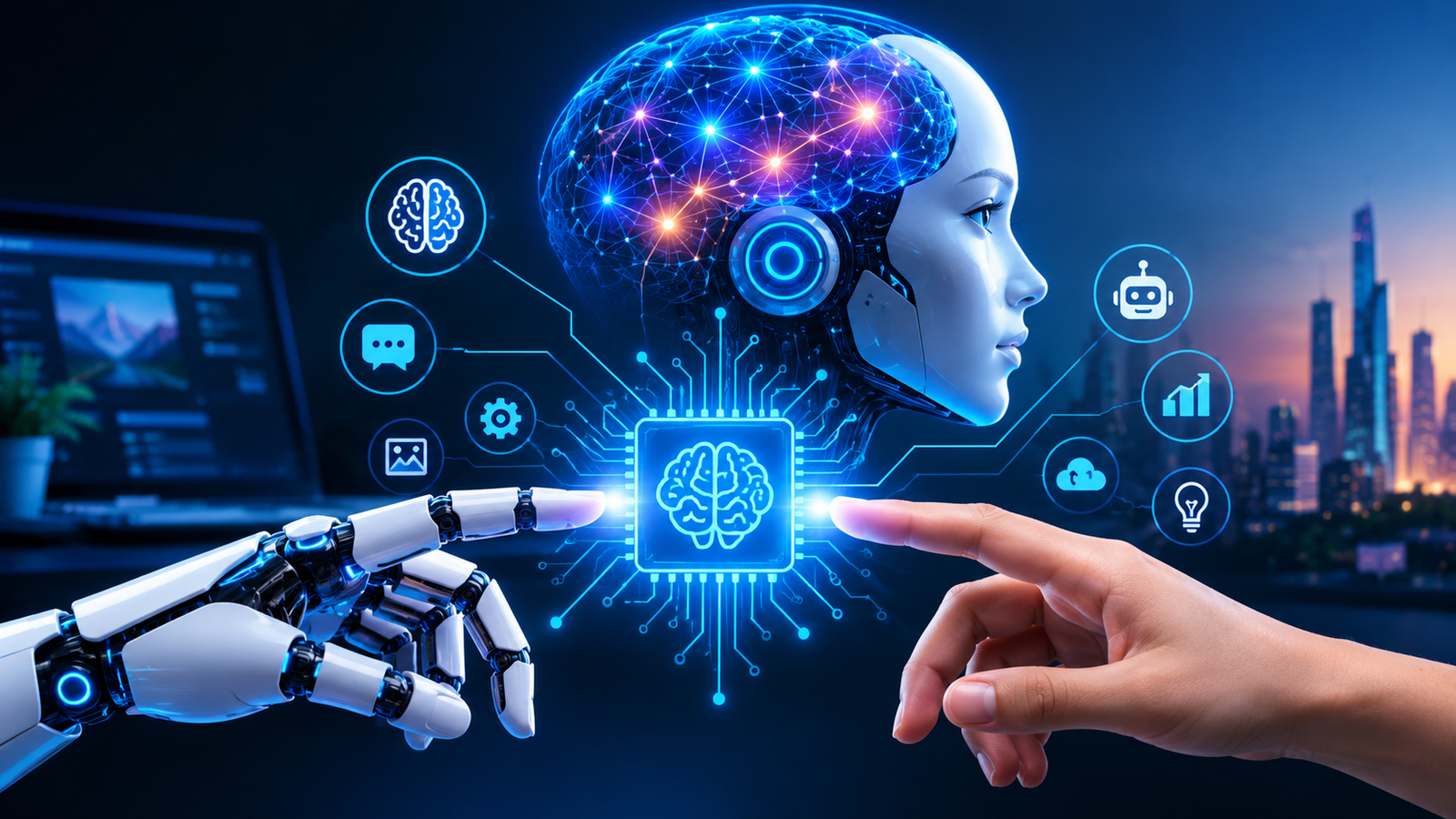
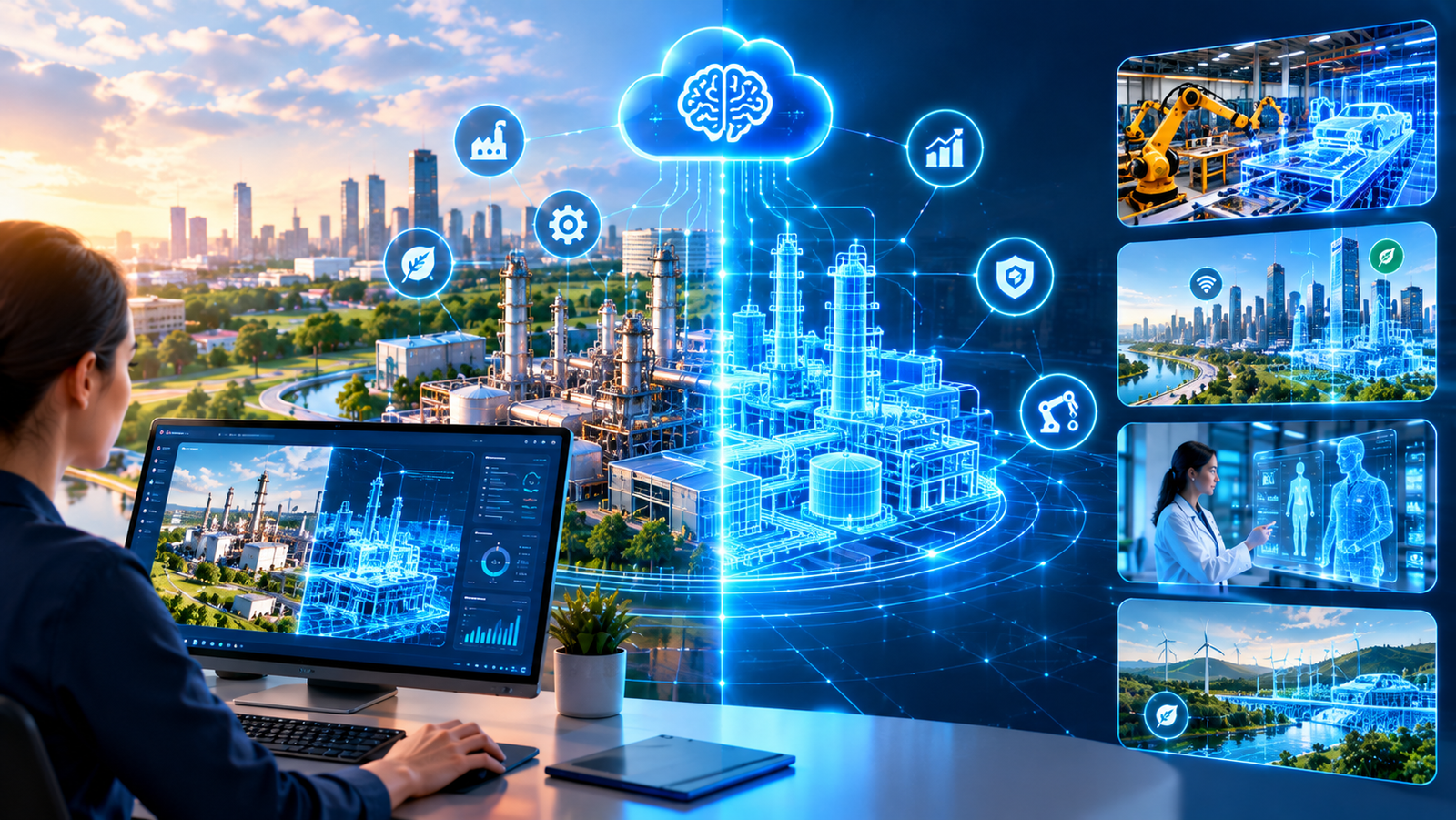
Artificial intelligence is evolving beyond chatbots, image generators, and automated assistants. One of the most exciting developments is the combination of AI with digital twin technology, which allows businesses to create intelligent virtual representations of real-world objects, machines, buildings, factories, and even entire cities. These virtual models can analyze information, simulate different situations, predict potential problems, and help people make better decisions before implementing changes in the physical world.
AI-powered digital twins are becoming increasingly important in manufacturing, healthcare, transportation, energy management, construction, and urban planning. By combining real-time data with machine learning and advanced simulations, organizations can understand how complex systems behave and identify opportunities for improvement.
Unlike traditional computer models that simply display information or simulate predefined conditions, AI-powered digital twins can learn from incoming data and continuously improve their predictions. This capability is transforming how organizations design products, manage infrastructure, reduce operational costs, and prepare for unexpected challenges.
As industries explore new ways to use intelligent technologies, AI-powered digital twins are emerging as a promising innovation that connects the physical and digital worlds.
What Is an AI-Powered Digital Twin?
A digital twin is a virtual representation of a physical object, system, or process. It uses information collected from the real world to reflect the condition, behavior, and performance of its physical counterpart.
For example, a manufacturing company might create a digital twin of an industrial machine. Sensors installed on the machine continuously collect information about temperature, vibration, operating speed, energy consumption, and other performance indicators. This information is transferred to the digital model, allowing engineers to monitor the machine without constantly inspecting it in person.
Artificial intelligence makes this technology more powerful by analyzing the collected information, identifying patterns, and predicting possible outcomes.
An AI-powered digital twin can help determine when a machine might require maintenance, how a production line could become more efficient, or how changing operating conditions might affect performance.
The technology can also simulate different scenarios. Before introducing a new manufacturing process, for instance, engineers can test its potential effects inside the digital environment instead of immediately experimenting with expensive physical equipment.
The result is a more intelligent system that helps organizations understand current conditions and make informed decisions about the future.
How Artificial Intelligence Enhances Digital Twin Technology
Traditional digital twins are useful for visualization, monitoring, and simulation. However, their capabilities depend on the quality of their data, the accuracy of their underlying models, and the assumptions built into their design.
Artificial intelligence expands these capabilities through several important functions.
1. Predictive Analysis
AI algorithms can analyze historical and real-time data to identify patterns that may indicate future problems.
In an industrial environment, an AI-powered digital twin might detect unusual vibrations or gradual temperature changes that suggest a machine component is deteriorating.
Instead of waiting for equipment to fail, maintenance teams can investigate the issue early and schedule repairs before a major breakdown occurs.
Predictive analysis can also help businesses forecast demand, estimate energy requirements, and evaluate how operational changes might influence future performance.
2. Continuous Learning
Machine learning systems can improve their predictions as they receive additional information.
Suppose a digital twin monitors a commercial building. Initially, its energy predictions may rely on historical consumption, occupancy estimates, and weather information.
Over time, the AI system can learn how the building responds to changing temperatures, different occupancy patterns, and adjustments to heating or cooling equipment.
This learning process can make future recommendations more relevant to actual operating conditions.
However, continuous improvement is not automatic. Models must be monitored, validated, and updated when conditions change significantly.
3. Intelligent Simulation
AI can help organizations explore possible outcomes before making real-world changes.
For example, an automobile manufacturer can simulate how modifications to a vehicle design might affect energy efficiency, performance, or component durability.
Engineers can compare multiple configurations and identify promising options before constructing physical prototypes.
These simulations can reduce experimentation costs and shorten development cycles, although important findings may still require physical testing.
4. Automated Decision Support
AI-powered digital twins can transform complex data into practical recommendations.
A logistics company might use a digital twin of its distribution network to evaluate delivery schedules, vehicle availability, traffic conditions, and warehouse capacity.
The system could identify alternative delivery routes or suggest adjustments to inventory distribution.
In most high-impact environments, human oversight remains important. AI-generated recommendations should be reviewed according to the risks involved, especially when they affect safety, finances, or critical infrastructure.
Major Applications of AI-Powered Digital Twins
The technology is not limited to one industry. Its flexibility allows organizations to create digital representations of individual products, entire facilities, and interconnected systems.
1. Smart Manufacturing and Industrial Automation
Manufacturing is one of the most promising areas for AI-powered digital twins.
Factories contain interconnected machines, production lines, supply systems, and quality-control processes. A problem in one area can affect the performance of the entire operation.
Digital twins allow manufacturers to monitor these relationships through a shared virtual environment.
When combined with AI, they can help identify production bottlenecks, predict equipment failures, and evaluate alternative manufacturing schedules.
For example, a factory producing electronic components could use a digital twin to understand why a particular production line experiences frequent delays. AI might discover that a combination of machine temperature, operating speed, and material availability contributes to the problem.
Managers could then test different operating conditions virtually and determine which changes are most likely to improve productivity.
Manufacturers can also use digital twins during product development. By testing designs and production methods in virtual environments, engineering teams can identify potential weaknesses before committing to expensive physical prototypes.
2. Healthcare and Personalized Treatment
Healthcare providers are exploring digital twins to improve medical research, equipment management, hospital operations, and treatment planning.
A hospital could develop a digital twin of its facility to examine patient movement, emergency department capacity, staffing requirements, and medical equipment availability.
AI could analyze this information to identify overcrowded areas and suggest more efficient resource allocation.
At the patient level, researchers are investigating digital representations of biological systems that combine medical records, imaging, laboratory results, and physiological measurements.
Such models could eventually help clinicians explore how different treatments might affect particular patients.
However, personalized medical digital twins remain an evolving field. A virtual model should not be assumed to reproduce the complete complexity of a human body or predict treatment outcomes with certainty.
Medical applications require rigorous validation, strong privacy protections, and appropriate clinical oversight before they can be relied upon for important healthcare decisions.
3. Smart Cities and Urban Planning
Cities are complex environments containing roads, buildings, public transportation systems, electricity networks, water infrastructure, and public services.
An AI-powered digital twin can bring information from these systems into a shared virtual model.
Urban planners can use the model to examine traffic congestion, evaluate infrastructure projects, and understand how proposed developments might affect nearby communities.
For example, before changing a major road intersection, a city could simulate different traffic signal configurations and evaluate their likely effects on vehicle movement.
AI could analyze traffic patterns, pedestrian activity, and historical congestion data to identify promising alternatives.
Digital twins can also support flood-risk assessment, emergency planning, and energy-efficient building development.
Nevertheless, citywide models depend on accurate information and careful consideration of privacy. They must also account for the needs of residents rather than focusing exclusively on efficiency or traffic flow.
4. Energy Management and Renewable Power
Energy systems are becoming more complicated as renewable sources, battery storage, electric vehicles, and distributed power generation become increasingly common.
AI-powered digital twins can help energy operators understand how these components interact.
A digital twin of a solar power installation, for instance, could combine information about panel performance, weather conditions, maintenance history, and electricity production.
AI models could estimate future output and identify equipment that may require inspection.
In wind energy, digital twins can help operators monitor turbine performance and evaluate how environmental conditions influence power generation.
Buildings can also benefit from this technology. A digital twin of an office complex could analyze occupancy, outdoor temperatures, electricity consumption, and heating or cooling performance to identify opportunities for energy savings.
These applications can improve planning and efficiency, although actual savings depend on system design, implementation costs, and the accuracy of predictions.
5. Transportation and Fleet Management
Transportation networks generate large volumes of data from vehicles, traffic systems, GPS devices, maintenance records, and logistics platforms.
Digital twins can combine these data sources to create a virtual representation of a fleet or transportation network.
AI can analyze the resulting information to improve vehicle scheduling, maintenance planning, and route selection.
A delivery company might use a digital twin to compare different warehouse locations and delivery strategies.
The system could examine how changes in traffic, vehicle availability, fuel consumption, and package volume affect delivery performance.
Rail operators could use similar approaches to monitor equipment conditions and evaluate maintenance schedules.
Airports might create digital twins to examine passenger movement, baggage handling, and resource allocation.
These applications can support more reliable transportation systems while helping organizations control operating costs.
The Role of Generative AI in Digital Twins
Generative AI is adding another layer of capability to digital twin technology.
Traditional digital twins often require specialized software, engineering knowledge, and detailed technical models. Generative AI can make these systems easier to interact with by allowing users to ask questions in natural language.
Imagine an engineer examining a digital twin of a production facility.
Instead of manually searching through multiple dashboards, the engineer could ask an AI assistant, “Why has production efficiency declined during the last two weeks?”
The system could analyze relevant sensor readings, maintenance logs, production records, and operational changes to identify possible explanations.
It might then suggest further tests or recommend simulations to investigate the issue.
Generative AI can also help summarize complex reports, explain technical findings, and assist with the creation of simulation scenarios.
In the future, engineers may be able to describe a proposed change in ordinary language and receive assistance translating it into a structured simulation.
However, generative AI can produce inaccurate explanations or recommendations. Any proposed changes should be checked against reliable data, engineering constraints, and safety requirements.
The strongest systems will combine conversational AI with validated engineering models rather than relying on generated responses alone.
Benefits of AI-Powered Digital Twins
Organizations adopt this technology for several practical reasons.
Reduced maintenance costs: Predictive models can help identify developing equipment problems before they lead to expensive failures.
Improved operational efficiency: Simulations can reveal bottlenecks and help organizations evaluate alternative processes.
Faster product development: Engineers can test designs virtually before investing in physical prototypes.
Better decision-making: Digital twins can bring information from multiple systems together, giving decision-makers a clearer view of complex operations.
Enhanced resource management: Organizations can use simulations to examine how equipment, staff, energy, and materials should be allocated.
Greater operational resilience: Scenario testing can help businesses prepare for disruptions, equipment failures, and changing demand.
Improved sustainability: Digital twins can help identify opportunities to reduce energy consumption, material waste, and unnecessary transportation.
These benefits are not guaranteed. They depend on reliable data, appropriate implementation, realistic models, and the organization’s ability to act on the information generated.
Challenges and Limitations
Despite its potential, AI-powered digital twin technology faces several important challenges.
High Implementation Costs
Developing a sophisticated digital twin can require sensors, cloud infrastructure, data integration, specialized software, and skilled technical teams.
Smaller businesses may find these initial investments difficult to justify.
A practical approach is to begin with one high-value asset or process rather than attempting to model an entire organization immediately.
Data Quality and Integration
Digital twins rely on information collected from physical systems. If sensors provide inaccurate readings or different platforms use incompatible data formats, the virtual model may produce misleading results.
Organizations need effective data-management practices and regular validation to maintain model accuracy.
Cybersecurity and Privacy
Connected digital twins can contain sensitive information about equipment, facilities, customers, and business operations.
Unauthorized access could expose confidential data or create risks if attackers interfere with connected systems.
Strong access controls, encryption, network security, monitoring, and appropriate data-retention policies are therefore essential.
Model Accuracy
A digital twin is a representation of reality, not reality itself.
Complex physical systems may behave in unexpected ways that a model cannot fully capture. AI predictions can also become less reliable when operating conditions change or when the system encounters situations missing from its training data.
Organizations should validate important predictions and clearly communicate uncertainty.
Skills and Organizational Readiness
Successful implementation often requires collaboration between data scientists, software developers, engineers, cybersecurity professionals, and operational managers.
Organizations may need to train employees and redesign existing workflows to benefit from the technology.
Without clear business objectives, even an advanced digital twin can become an expensive system that produces information without improving decisions.
How Businesses Can Begin Using AI Digital Twins
Companies interested in this technology should start with a clearly defined business problem.
First, identify a process where better prediction or simulation could deliver measurable value. Examples include reducing machine downtime, lowering building energy consumption, or improving delivery schedules.
Second, determine which data sources are available and whether their quality is sufficient for the intended application.
Third, build a limited digital twin covering a specific machine, facility, or workflow. A focused pilot project is easier to evaluate than a large system covering multiple departments.
Fourth, introduce AI capabilities that directly address the chosen problem. Predictive maintenance, anomaly detection, or demand forecasting may be appropriate starting points.
Fifth, compare the results with existing performance indicators. Businesses should measure factors such as maintenance costs, equipment availability, energy consumption, prediction accuracy, and employee productivity.
Finally, expand the project only when the results justify further investment.
This step-by-step approach can help organizations control costs, identify technical problems early, and develop a realistic strategy for wider adoption.
The Future of AI-Powered Digital Twins
The future of digital twin technology will likely involve greater integration with robotics, Internet of Things devices, cloud computing, edge computing, and generative AI.
As sensors become more capable and computing infrastructure improves, organizations may be able to create more detailed representations of complex physical environments.
Robotics companies could use digital twins to evaluate machine movements before deploying robots in factories or warehouses. Construction firms could connect building information models with real-time operational data to monitor completed structures. Energy providers could simulate interactions among renewable generation, storage systems, and electricity demand.
Another important development is the possibility of creating interconnected digital twins. Instead of representing one machine or building in isolation, these systems could model relationships among suppliers, factories, transportation networks, and customers.
Such interconnected environments could help businesses understand how a disruption in one location affects operations elsewhere.
However, the future will depend on more than technological progress. Data standards, interoperability, cybersecurity, model validation, and responsible AI governance will influence how widely digital twins can be adopted.
Organizations will also need to determine which decisions can safely be automated and which require human judgment.
The most successful implementations are likely to combine advanced predictions with transparent processes, measurable objectives, and appropriate human oversight.
Conclusion
AI-powered digital twins represent an important development in the relationship between artificial intelligence and the physical world. By combining real-time information, virtual modeling, machine learning, and simulation, they allow organizations to understand complex systems, investigate potential problems, and evaluate decisions before implementing changes.
Their applications extend across manufacturing, healthcare, transportation, energy management, and urban planning. Businesses can use them to improve maintenance strategies, optimize resource allocation, reduce waste, and support more informed decision-making.
Nevertheless, successful implementation requires reliable data, suitable infrastructure, cybersecurity protections, and realistic expectations. Digital twins cannot eliminate uncertainty or replace every form of human expertise.
As AI technologies continue to mature, digital twins could become increasingly valuable tools for designing, monitoring, and managing the systems people depend on every day. Their greatest contribution may be the ability to test possibilities in a virtual environment before making expensive or consequential changes in the real world.