Introduction
Artificial intelligence is evolving far beyond chatbots, image generators, and automated assistants. One of the most promising developments is the combination of AI with digital twin technology. This innovative approach allows businesses, engineers, researchers, and urban planners to create virtual representations of real-world objects, systems, and environments. These digital models can analyze data, simulate different situations, and help people make better decisions before implementing changes in the physical world.
AI-powered digital twins are transforming industries by connecting real-time information with intelligent predictions. From monitoring industrial machinery to designing smarter cities, this technology is creating new opportunities to improve efficiency, reduce operational costs, and solve complex problems.
Unlike traditional computer simulations, which often rely on predefined assumptions, AI-powered digital twins can continuously learn from incoming information and adjust their predictions as conditions change. This makes them valuable tools for organizations seeking to understand complicated systems and prepare for future challenges.
As artificial intelligence becomes more capable, digital twins could become an important part of how companies design products, manage infrastructure, improve healthcare services, and operate their businesses.
What Are AI-Powered Digital Twins?
A digital twin is a virtual representation of a physical object, process, or system. It uses information collected from the real world to reflect the condition, performance, and behavior of its physical counterpart.
For example, a manufacturing company might create a digital twin of an industrial machine. Sensors installed on the physical machine collect information about temperature, vibration, energy consumption, and operating speed. This information is transferred to the digital model, allowing engineers to monitor performance without constantly inspecting the equipment manually.
Artificial intelligence makes this process more powerful.
AI algorithms can examine large volumes of operational data, recognize patterns, detect unusual behavior, and estimate what might happen under different conditions. Instead of simply showing the current state of a machine, an AI-powered digital twin can help predict when maintenance may be required or how a proposed operational change could affect performance.
These systems typically combine several technologies, including machine learning, Internet of Things sensors, cloud computing, data analytics, and simulation software.
The result is a dynamic digital environment that helps people understand real-world systems more effectively.
How Artificial Intelligence Improves Digital Twin Technology
Traditional digital twins can display information and simulate physical processes, but their capabilities depend heavily on the quality of their models and the information supplied to them.
Artificial intelligence introduces additional analytical capabilities that make digital twins more adaptive and useful.
1. Predictive Analysis
One of the most important benefits of AI is its ability to identify patterns in historical and real-time data.
An AI-powered digital twin can analyze information from equipment to identify signs of possible failure. For instance, small changes in vibration or temperature might indicate that a motor is gradually deteriorating.
Rather than waiting for the machine to break down, maintenance teams can investigate the problem early.
This approach, commonly known as predictive maintenance, can help organizations reduce unexpected downtime, prevent expensive repairs, and improve equipment reliability.
2. Real-Time Monitoring
Digital twins can receive information from connected sensors and other data sources. AI systems process this information to identify changing conditions and highlight potential concerns.
In a commercial building, for example, a digital twin could monitor electricity consumption, indoor temperature, ventilation performance, and equipment operation.
AI could then recommend adjustments to heating, cooling, or lighting systems based on occupancy patterns and environmental conditions.
Real-time monitoring enables businesses to respond more quickly when performance deviates from expectations.
3. Scenario Testing
Another major advantage is the ability to test different scenarios in a virtual environment.
Before introducing a new manufacturing process, a company could use a digital twin to evaluate different production schedules, equipment configurations, or resource allocations.
AI can help analyze the results and identify configurations that may improve efficiency.
This reduces the need to experiment directly with expensive physical equipment and allows decision-makers to explore potential outcomes with fewer operational risks.
However, simulations remain dependent on the accuracy of their underlying models and assumptions. Their predictions should therefore be validated before important real-world decisions are made.
4. Continuous Optimization
AI-powered digital twins can help organizations identify opportunities for ongoing improvement.
As new information becomes available, machine learning models may update their predictions and reveal changes in system performance.
For example, a logistics company could use a digital twin to analyze vehicle movements, warehouse activity, delivery schedules, and fuel consumption.
The system might identify inefficient routes, congested warehouse areas, or opportunities to improve vehicle utilization.
Human operators can then use these insights to make informed adjustments.
Major Applications of AI-Powered Digital Twins
The potential applications of this technology extend across numerous industries. Each sector can use digital twins differently, depending on its operational requirements and the information available.
1. Smart Manufacturing
Manufacturing is one of the most promising areas for AI-powered digital twins.
Factories rely on complicated combinations of machinery, production lines, inventory systems, and quality-control processes. A small disruption in one part of a production line can affect the entire operation.
Digital twins help manufacturers build virtual representations of machines, production facilities, and manufacturing processes.
AI can analyze equipment performance, identify production bottlenecks, and estimate maintenance requirements.
For example, a factory producing electronic components could create a digital twin of its assembly line. The system could analyze production speed, machine downtime, material usage, and defect rates.
Engineers could then test alternative production schedules or machine settings in the virtual environment.
These insights may help manufacturers increase productivity, improve product quality, and reduce waste.
Digital twins can also support product development by allowing engineers to simulate how a product might perform under different operating conditions before manufacturing physical prototypes.
2. Smart Cities and Urban Planning
Cities face increasing pressure to manage traffic, energy consumption, public transportation, waste collection, and infrastructure maintenance.
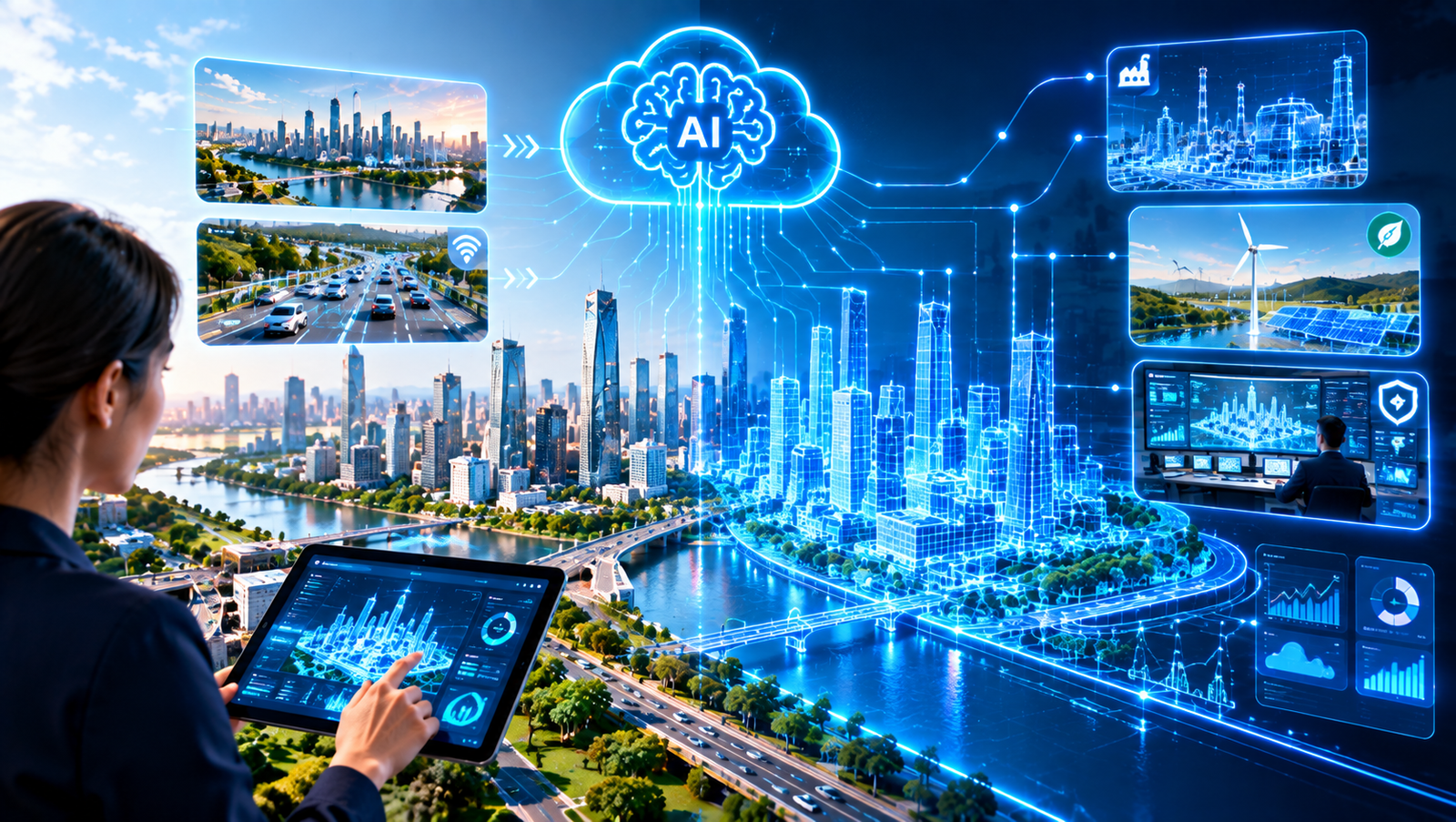
AI-powered digital twins can help urban planners understand how these interconnected systems operate.
A city digital twin might combine information from traffic sensors, public transportation networks, weather services, utility systems, and geographic data.
AI algorithms can use this information to analyze congestion patterns, forecast infrastructure demand, and evaluate potential planning decisions.
For instance, planners considering a new road could simulate how it might affect traffic movement in surrounding neighborhoods.
They could also investigate how changes to traffic signals or public transportation routes might influence travel times.
Digital twins may support emergency planning as well. Authorities could model the potential effects of flooding, severe weather, or major transportation disruptions.
Although these models cannot eliminate uncertainty, they can provide valuable information for planning and resource allocation.
3. Healthcare and Personalized Treatment
Healthcare is another area where digital twin technology is attracting attention.
Researchers and healthcare organizations are exploring ways to create digital representations of medical equipment, hospital operations, biological systems, and aspects of individual patients.
For example, a hospital could develop a digital twin of its operational environment to understand patient movement, staff availability, equipment utilization, and waiting times.
AI could help administrators identify bottlenecks and evaluate alternative staffing arrangements.
In medical research, digital models can support simulations of biological processes and help researchers investigate how different variables may influence outcomes.
Personalized digital representations of patients are a more complex application. Researchers are investigating how patient records, medical imaging, physiological measurements, and computational models might eventually support individualized treatment planning.
However, a digital patient model is not a complete or perfectly accurate representation of human biology. Clinical use requires careful validation, privacy protection, and appropriate medical supervision.
4. Energy Management and Renewable Power
Energy providers must balance electricity supply and demand while maintaining the stability of power networks.
The growing use of solar and wind energy makes this task more complicated because renewable generation can change with weather conditions.
AI-powered digital twins can help model power plants, electricity networks, renewable installations, and energy storage systems.
A digital twin of a solar farm, for example, could combine weather forecasts, panel performance data, maintenance records, and electricity generation measurements.
AI could analyze these inputs to estimate future output and identify equipment that may require inspection.
Electricity network operators could also use digital twins to study demand patterns and evaluate the effects of adding new renewable energy sources.
These applications may help improve operational planning, reduce energy losses, and support more efficient resource management.
5. Transportation and Logistics
Transportation networks involve vehicles, roads, warehouses, delivery schedules, and distribution centers.
AI-powered digital twins can help companies understand how these components interact.
A logistics business could create a digital representation of its distribution network, incorporating information about vehicle locations, inventory levels, delivery requirements, and traffic conditions.
AI could then simulate alternative delivery schedules or distribution strategies.
For example, if severe weather affects a major highway, the system could help evaluate alternative routes and estimate their impact on delivery times.
Vehicle manufacturers can also use digital twins to study engine performance, battery behavior, and component wear.
In electric vehicles, digital models can help engineers investigate battery temperature, charging behavior, and energy consumption under different driving conditions.
These insights may support improved vehicle design and maintenance planning.
6. Construction and Building Management
Construction projects frequently experience delays, budget overruns, and coordination problems.
Digital twins can provide a shared virtual representation of a building or infrastructure project, combining design information with construction progress and operational data.
AI can help analyze project schedules, identify possible conflicts, and highlight deviations from planned work.
After a building becomes operational, its digital twin can support facility management.
For instance, a commercial office building could use sensors to monitor ventilation, lighting, temperature, and electricity consumption.
AI might identify opportunities to reduce unnecessary energy use while maintaining comfortable indoor conditions.
Building managers could also use digital twins to investigate maintenance requirements and evaluate the potential effects of equipment upgrades.
Benefits of AI-Powered Digital Twins
The integration of AI with digital twin technology offers several important advantages.
Better decision-making: Digital twins help organizations examine complex systems and compare potential outcomes before making changes in the physical world.
Reduced operational costs: Predictive maintenance and improved resource allocation may reduce unnecessary expenses and unexpected equipment failures.
Improved productivity: AI can identify inefficiencies in production lines, transportation systems, and business operations.
Lower development risks: Engineers can test product designs, equipment configurations, and operational strategies virtually before committing to expensive physical implementations.
Greater resource efficiency: Digital twins can help organizations monitor energy consumption, material usage, and equipment performance.
Faster problem identification: Continuous monitoring and anomaly detection can help operators identify potential problems earlier.
Improved collaboration: A shared digital model can help engineers, managers, technicians, and planners work with consistent information.
The actual benefits depend on implementation quality, data accuracy, operating conditions, and how effectively organizations use the insights generated by these systems.
Challenges and Limitations
Despite their potential, AI-powered digital twins are not easy to implement. Organizations must address several technical, financial, and operational challenges.
Data Quality and Availability
Digital twins depend on reliable information from physical systems.
If sensors provide inaccurate measurements or important data is missing, the digital model may produce misleading results.
Organizations need appropriate data collection processes, validation procedures, and monitoring systems to maintain reliability.
High Implementation Costs
Developing a sophisticated digital twin may require sensors, software, cloud infrastructure, specialist personnel, and integration with existing systems.
These costs can be significant, particularly for smaller businesses.
Organizations should begin with clearly defined use cases where measurable benefits justify the investment.
Cybersecurity and Privacy
Connected digital twins may process sensitive information about buildings, industrial equipment, transportation networks, or healthcare operations.
Unauthorized access could expose confidential information or disrupt critical systems.
Strong authentication, access controls, encryption, security monitoring, and regular software updates are important safeguards.
Healthcare applications require additional attention to patient privacy and applicable data-protection requirements.
Model Accuracy
An AI-powered digital twin is still a model of reality rather than reality itself.
It may not fully capture unusual events, unexpected human behavior, environmental changes, or complex interactions between systems.
Predictions should be treated as decision-support information rather than guaranteed outcomes.
Skills and Integration
Implementing digital twins often requires collaboration among software engineers, data scientists, domain specialists, and operational teams.
Organizations may struggle to find employees with the necessary combination of skills.
Integrating digital twins with older equipment and existing enterprise software can also require considerable time and technical expertise.
The Role of Generative AI in Digital Twins
Generative AI is creating new possibilities for interacting with digital twins.
Traditional digital twin platforms often require users to understand specialized dashboards, simulation tools, and technical data.
Generative AI could make these systems easier to use through conversational interfaces.
For example, a factory manager might ask, “Why did production efficiency decline this week?”
An AI assistant connected to a reliable digital twin could examine equipment performance, maintenance records, production schedules, and relevant operational measurements.
It could then summarize possible contributing factors and identify areas that require further investigation.
Similarly, an engineer might ask the system to compare two equipment configurations or explain the likely effects of changing a production schedule.
Generative AI can also help summarize simulation results, generate reports, and assist with technical documentation.
However, language models can produce inaccurate explanations or recommendations. Their outputs should be grounded in verified operational data and checked by qualified personnel, especially when decisions involve safety or substantial financial consequences.
AI-Powered Digital Twins and the Future of Business
Businesses are increasingly looking for ways to make operations more measurable, adaptable, and efficient.
AI-powered digital twins offer a framework for connecting physical activities with digital analysis.
In the future, organizations may use these systems throughout a product’s lifecycle.
During product development, engineers could simulate different designs. During manufacturing, digital twins could monitor production and identify quality issues. After products reach customers, connected systems could help analyze performance and anticipate maintenance needs.
This creates opportunities to improve products and processes using information collected throughout their operational lives.
Smaller businesses may also benefit as cloud-based software, standardized data connections, and more accessible AI tools reduce some barriers to adoption.
Nevertheless, widespread adoption will depend on affordability, interoperability, data governance, and demonstrable business value.
Companies that approach digital twin technology strategically may gain useful insights into their operations. Those that invest without clear objectives or reliable data may find that sophisticated models deliver limited practical benefits.
How Businesses Can Begin Using Digital Twins
Organizations interested in this technology do not necessarily need to create a complete digital replica of their operations immediately.
A gradual implementation strategy can help reduce costs and complexity.
Step 1: Identify a specific problem. Start with a measurable challenge, such as frequent equipment failures, excessive energy consumption, or production delays.
Step 2: Evaluate available data. Determine whether existing sensors, business systems, and operational records provide sufficient information.
Step 3: Select an appropriate use case. Choose a process where simulation or predictive analysis could create measurable value.
Step 4: Develop a limited digital model. Build a digital twin for one machine, building, production line, or operational process.
Step 5: Introduce AI capabilities. Add predictive analytics, anomaly detection, or optimization features where they offer a clear advantage.
Step 6: Validate the results. Compare the digital twin’s predictions with real-world outcomes and investigate significant discrepancies.
Step 7: Expand carefully. Extend the system to additional processes after demonstrating reliable performance and practical benefits.
This approach allows organizations to learn from smaller projects before making larger investments.
Conclusion
AI-powered digital twins represent an important development in the relationship between artificial intelligence and the physical world. By combining real-time data, virtual models, machine learning, and simulation, these systems can help organizations understand complex processes and make better-informed decisions.
Their applications range from predictive maintenance in manufacturing to urban planning, healthcare research, renewable energy management, transportation, and building operations.
Although challenges involving cost, data quality, cybersecurity, and model accuracy remain, continued improvements in AI and connected technologies may make digital twins more accessible and useful.
The greatest value of this technology lies not in creating virtual copies for their own sake, but in using those copies to solve real problems. Organizations that connect digital modeling with reliable data, clear objectives, and human expertise may be better positioned to improve efficiency, manage uncertainty, and develop innovative solutions.
As AI continues to advance, digital twins could become an increasingly important tool for designing, monitoring, and improving the systems that shape everyday life.