Introduction
Robotics is transforming industries around the world, from manufacturing and healthcare to transportation and logistics. One of its most promising applications is agriculture, where intelligent machines are helping farmers improve productivity, reduce labor-intensive tasks, and manage resources more efficiently. As the global population grows and environmental challenges become more demanding, agricultural robotics is emerging as an important part of the future of food production.
Traditional farming depends heavily on human labor, favorable weather conditions, and manual decision-making. Farmers must monitor crops, remove weeds, apply fertilizers, manage irrigation, and harvest produce at the right time. These responsibilities can become increasingly difficult when labor shortages, rising production costs, and unpredictable weather affect agricultural operations.
Robotic technology offers new ways to address these challenges. Modern agricultural robots can navigate fields, identify crop diseases, pick fruits, plant seeds, and remove weeds with impressive precision. Some systems use artificial intelligence, computer vision, sensors, and GPS technology to make decisions based on real-time information.
Unlike conventional agricultural machinery, which often performs repetitive tasks according to predefined instructions, intelligent agricultural robots can analyze their surroundings and adjust their actions to changing conditions.
This article explores how robotics is changing agriculture, the technologies behind these systems, their practical applications, their benefits and limitations, and what the future may hold for farmers and food production.
What Is Agricultural Robotics?
Agricultural robotics refers to the use of automated machines and intelligent robotic systems to perform tasks related to farming, crop management, livestock care, and agricultural processing.
These robots may operate independently, work under human supervision, or collaborate with farm workers. Their capabilities depend on their design, software, sensors, and the agricultural environment in which they operate.
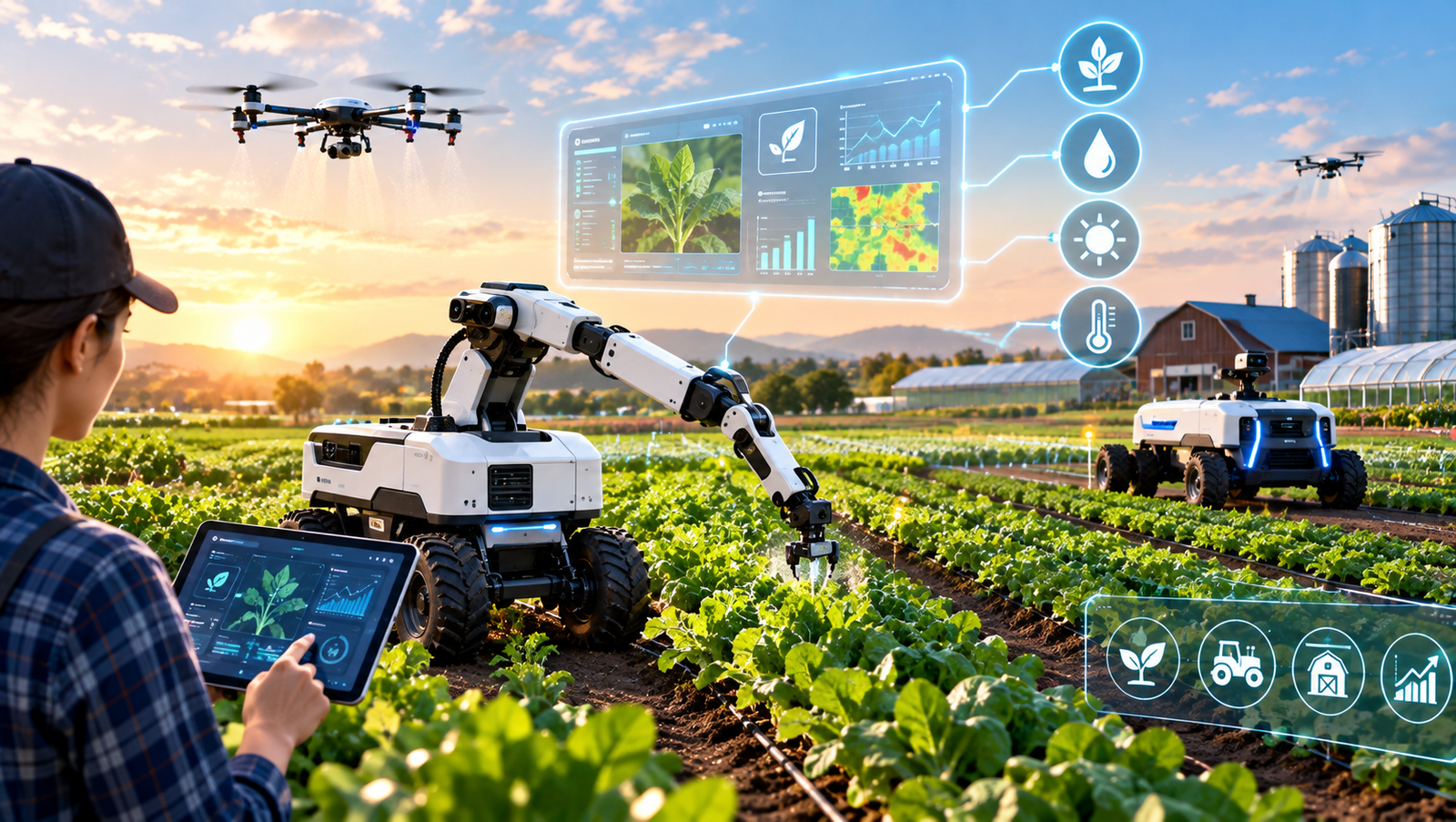
Agricultural robots come in different forms, including autonomous tractors, robotic weeders, fruit-picking machines, agricultural drones, and automated livestock-monitoring systems.
Some robots are designed to work across large fields, while others specialize in delicate tasks that require precision. For example, a robotic harvesting system must distinguish ripe fruit from unripe fruit without damaging the plant. A robotic weeder must identify unwanted vegetation while avoiding nearby crops.
These responsibilities require a combination of mechanical engineering, artificial intelligence, environmental sensing, and sophisticated control systems.
The primary objective of agricultural robotics is not simply to replace human labor. It is to help farmers perform difficult tasks more consistently, use resources more effectively, and make better-informed decisions.
1. Autonomous Robots for Precision Farming
Precision farming is an agricultural approach that uses data and technology to manage crops according to their specific needs. Rather than treating an entire field uniformly, farmers can identify differences in soil quality, moisture levels, nutrient availability, and plant health.
Robotics makes this approach more practical by enabling machines to collect information and perform targeted actions.
Autonomous agricultural robots can travel through fields while gathering data from cameras, sensors, and navigation systems. They may measure plant growth, identify dry areas, inspect crop conditions, and detect locations where additional attention is required.
For example, a robot moving through a vegetable field might identify sections where plants are growing poorly. The collected information can help farmers investigate whether the problem is related to insufficient water, soil conditions, pests, or disease.
Some robotic systems can also perform specific operations based on their observations. Instead of applying the same quantity of a treatment across an entire field, a machine may target individual plants or selected areas.
This approach can help reduce unnecessary input use while supporting healthier crops.
Autonomous robots are particularly useful for repetitive field operations because they can follow planned routes and perform tasks with limited direct supervision. However, their performance depends on field conditions, navigation accuracy, battery capacity, and the quality of their sensing systems.
2. Robotic Weed Removal Without Excessive Chemical Use
Weed management is one of the most demanding responsibilities in agriculture. Weeds compete with crops for sunlight, water, nutrients, and space. If they are not controlled effectively, they can reduce crop growth and affect harvest quality.
Traditional weed control methods include manual removal, mechanical cultivation, and herbicide application. Although these methods remain important, they may require substantial labor or involve environmental and operational challenges.
Robotic weeders offer another option.
These machines use cameras and computer vision to distinguish crops from unwanted plants. Artificial intelligence models can analyze the shape, color, size, and location of vegetation to identify which plants should remain and which should be removed.
After detecting a weed, the robot may use a mechanical cutting tool, a small cultivator, or another targeted mechanism to eliminate it.
Some systems are designed to work between crop rows, while more advanced machines can operate close to individual plants.
The main advantage is precision. A robotic weeder may treat a specific weed instead of disturbing a larger area of soil or applying chemicals across an entire field.
This technology could be particularly valuable for organic farms, vegetable growers, and agricultural operations seeking to reduce herbicide use.
Nevertheless, robotic weed removal is not suitable for every crop or field. Dense vegetation, uneven terrain, changing light conditions, and closely spaced plants can make identification difficult. Farmers must choose equipment appropriate for their crops and growing conditions.
3. AI-Powered Fruit-Picking Robots
Harvesting delicate fruits is a challenging task because produce must often be collected at the correct stage of ripeness without bruising or damaging it.
Strawberries, apples, tomatoes, peppers, and other fruits may require careful handling. Their shapes, sizes, positions, and levels of ripeness can vary considerably, even within the same plant.
This makes fruit harvesting an important application of intelligent robotics.
A fruit-picking robot typically combines several technologies:
- Cameras and computer vision to locate fruit.
- Artificial intelligence to estimate ripeness.
- Robotic arms to reach individual fruits.
- Specialized grippers to hold produce gently.
- Sensors to monitor contact and gripping force.
- Navigation systems to move between plants or rows.
When a robot identifies a suitable fruit, its software calculates how to approach it. The robotic arm then moves toward the target and uses an appropriate tool to detach the fruit.
The harvested produce may be placed into a collection container for later transportation.
The process sounds straightforward, but real-world harvesting presents significant difficulties. Fruit may be hidden behind leaves, branches can obstruct robotic arms, and lighting conditions can change throughout the day.
Soft fruit requires especially careful handling because excessive pressure can cause damage.
As computer vision, robotic manipulation, and machine-learning models improve, automated harvesting may become increasingly practical for selected crops.
For farmers facing seasonal labor shortages, these systems could help improve harvesting consistency and reduce the amount of produce left uncollected. However, the economics depend on crop type, equipment cost, operating speed, and maintenance requirements.
4. Agricultural Drones and Flying Robots
Flying robots, commonly known as agricultural drones, are becoming useful tools for observing and managing farmland.
Unlike ground-based robots, drones can cover large areas quickly and collect information from above. They are especially valuable for monitoring fields that are difficult to inspect manually.
Agricultural drones may carry high-resolution cameras, thermal sensors, or multispectral imaging equipment. These tools can reveal differences in crop growth, vegetation health, and surface temperature.
For example, thermal imaging may help identify areas experiencing water stress. Multispectral imagery can reveal variations in vegetation conditions that are not always obvious to the human eye.
Farmers can use these observations to investigate potential problems before they spread across a field.
Depending on the equipment and local regulations, agricultural drones may also support targeted spraying, seed distribution, or other specialized operations.
However, drones do not automatically solve every agricultural problem. Aerial images require appropriate interpretation, and detecting an unhealthy crop does not necessarily reveal the exact cause of the problem.
Weather, flight endurance, battery limitations, payload capacity, and legal restrictions can also affect their usefulness.
The most effective systems combine drone observations with ground inspections, soil measurements, and other agricultural information.
5. Robotic Irrigation and Water Management
Water management is becoming increasingly important as farmers deal with droughts, changing rainfall patterns, and pressure on freshwater resources.
Traditional irrigation systems may operate according to fixed schedules, even when different parts of a field have different water requirements.
Robotics, sensors, and intelligent control systems can help make irrigation more responsive.
Autonomous irrigation equipment can use soil-moisture sensors, weather information, and crop-growth data to determine when and where watering is needed.
A robotic platform may move through a field, measure soil conditions, and transmit information to a central irrigation system. Alternatively, automated valves and connected irrigation equipment can control water delivery without requiring a mobile robot.
For example, sandy soil may lose moisture more quickly than heavier soil. A precision irrigation system can account for these differences and help avoid treating every area identically.
Some systems can also incorporate weather forecasts to reduce unnecessary watering before expected rainfall.
Robotic irrigation technology can support more efficient water use, healthier crops, and reduced labor requirements. Its effectiveness depends on sensor accuracy, system design, crop needs, and the quality of the underlying data.
Farmers must also consider installation costs and the availability of reliable connectivity and maintenance services.
6. Robots for Livestock Monitoring and Care
Agricultural robotics extends beyond crop production. Livestock farming also benefits from automated machines and intelligent monitoring systems.
Farmers must regularly monitor animal health, feeding behavior, movement, cleanliness, and environmental conditions. These tasks can become difficult on large farms where animals require frequent observation.
Robotic systems can help automate some of these responsibilities.
In dairy farming, robotic milking systems allow eligible cows to enter a milking station where equipment identifies the animal and performs the milking process under controlled conditions.
Sensors can record information such as milk production and milking activity. Depending on the system, this information can help farmers identify changes that may require further investigation.
Other robots can clean livestock housing, distribute feed, or move materials around farm facilities.
Automated feeding systems can deliver measured quantities of food according to established feeding plans. Robotic cleaning equipment can help maintain suitable conditions in barns and livestock buildings.
Wearable sensors and automated monitoring platforms can also track movement and behavioral patterns. Unusual changes may indicate discomfort, illness, or changes in normal activity, although such signals require appropriate interpretation.
These technologies can improve farm management and reduce repetitive work. However, automated systems should complement, rather than eliminate, regular animal observation and veterinary care.
7. Artificial Intelligence Makes Agricultural Robots Smarter
Artificial intelligence is one of the most important technologies supporting modern agricultural robotics.
A conventional machine generally performs tasks according to predefined instructions. An AI-enabled robot can use data to recognize patterns, classify objects, and adjust certain actions to changing conditions.
Computer vision allows agricultural robots to interpret images captured by cameras. These systems can identify plants, estimate fruit ripeness, detect weeds, and recognize visible signs of crop damage.
Machine learning helps systems improve their ability to classify observations when they are trained on suitable datasets.
For instance, an agricultural robot may be trained to distinguish a crop plant from several common weed species. Once deployed, it can analyze camera images and estimate which plants belong to each category.
Other AI applications include predicting crop yields, identifying abnormal plant growth, and estimating the likelihood of certain agricultural problems.
AI can also help robots plan routes, avoid obstacles, and select appropriate movements for particular tasks.
However, artificial intelligence is not infallible. A model trained using images from one region may perform less effectively in a different climate, soil type, or growing environment.
Changes in lighting, plant varieties, dust, rain, and field conditions can also affect accuracy.
Reliable agricultural AI therefore requires appropriate training data, field testing, regular evaluation, and mechanisms for human oversight.
8. Robotics in Greenhouses and Indoor Farming
Greenhouses and indoor farms provide controlled environments where robotic systems can perform repetitive operations with greater predictability than in many outdoor fields.
These facilities often grow vegetables, herbs, leafy greens, and other crops that require regular monitoring and handling.
Robots can support planting, transplanting, watering, crop inspection, harvesting, and the transportation of produce.
Automated systems may move trays between growing areas, monitor plant development, or transport harvested crops to packing stations.
In vertical farming facilities, where crops are grown in stacked layers, automated handling equipment can help manage trays and move materials through limited spaces.
Robotic systems can also work alongside environmental sensors that monitor temperature, humidity, light intensity, and nutrient conditions.
This combination can help operators identify problems early and maintain more consistent growing conditions.
Indoor environments can simplify some robotic tasks because lighting, spacing, and temperature may be more controlled. Nevertheless, these farms require substantial investment in infrastructure, energy, automation equipment, and environmental management.
Robotics can improve operational efficiency, but it does not automatically make indoor farming economically viable. Profitability depends on crop value, energy prices, production methods, and market demand.
9. Autonomous Tractors and Smart Agricultural Machinery
Tractors remain central to many farming operations. They are used for ploughing, planting, spraying, cultivating, and transporting materials.
Autonomous tractor technology aims to automate some of these operations using navigation systems, cameras, radar, and other sensors.
Depending on the system, a tractor may follow predefined field routes, maintain consistent spacing between rows, or perform selected tasks with limited direct operator input.
GPS-based guidance can help machinery follow accurate paths, reducing unnecessary overlap during field operations.
More advanced systems use environmental sensors to detect obstacles and adjust movement when necessary.
Autonomous machinery may be especially valuable for repetitive work over large areas. It can also support longer operating periods when appropriate supervision, maintenance, and safety arrangements are available.
However, autonomous tractors must handle changing terrain, unexpected obstacles, equipment failures, and weather conditions.
Their deployment requires careful assessment of safety, operating costs, technical support, and applicable regulations.
In many cases, semi-autonomous machinery that assists a human operator may be more practical than fully unattended operation.
10. The Benefits of Agricultural Robotics
Agricultural robotics can provide several advantages when implemented appropriately.
Improved productivity
Robots can automate repetitive tasks such as crop monitoring, weed removal, and material transportation. This allows farm workers to devote more time to activities that require judgment, planning, and specialized knowledge.
Greater precision
Robotic systems can target individual plants, specific field areas, or selected operations. Precision can reduce unnecessary work and improve the consistency of agricultural processes.
Reduced dependence on manual labor
Some farming activities are physically demanding and difficult to staff during short seasonal periods. Robots can help reduce dependence on manual labor for selected tasks, although human workers remain necessary for supervision, maintenance, and many specialized operations.
More efficient resource use
Targeted irrigation, precise spraying, and robotic weed control can help reduce waste. The extent of these savings depends on the technology, crop, and operating conditions.
Better crop monitoring
Sensors and cameras can collect observations more frequently than manual inspections alone. This may help farmers identify emerging problems earlier and respond more effectively.
Potential improvements in working conditions
Robots can undertake certain repetitive or physically demanding operations. This may reduce workers’ exposure to some difficult tasks, provided the equipment is operated and maintained safely.
Support for data-driven decisions
Agricultural robots can generate useful information about crop conditions, machine performance, and field variability. When interpreted correctly, this information can support better farm management.
11. Challenges Facing Agricultural Robotics
Despite its potential, agricultural robotics faces several important obstacles.
High Initial Investment
Robotic equipment can require significant upfront expenditure. Small farms may find it difficult to justify purchasing specialized machines when their operating areas or production volumes are limited.
In addition to the purchase price, farmers must consider software subscriptions, spare parts, repairs, charging infrastructure, and technical support.
Equipment-sharing arrangements, leasing, and robotics-as-a-service models may help reduce these barriers.
Difficult Outdoor Conditions
Agricultural environments are unpredictable. Mud, dust, rain, uneven terrain, changing sunlight, and dense vegetation can interfere with sensors and mechanical systems.
A robot that performs reliably in a controlled greenhouse may struggle in a large outdoor field.
Manufacturers must therefore design machines for the specific environments and crops in which they will operate.
Technical Maintenance
Robotic systems combine mechanical components, electronics, software, and sensors. A failure in any of these areas may interrupt operations.
Farmers need access to spare parts, repair services, software updates, and personnel who understand the equipment.
Without reliable support, even advanced machinery can become expensive and difficult to maintain.
Connectivity Limitations
Some agricultural technologies depend on mobile networks, cloud services, or internet connectivity. Rural areas may not always have reliable coverage.
Local processing, offline operation, and robust communication systems can help reduce this dependence.
Workforce Adaptation
Automation may change the skills required in agriculture. Some repetitive tasks may require fewer workers, while demand may increase for technicians, equipment operators, data specialists, and agricultural technology professionals.
Training and workforce development will be important to help people adapt to these changes.
Safety and Reliability
Robots operating around people, animals, and machinery must be designed with appropriate safety features.
Emergency stops, obstacle detection, operating boundaries, and clear supervision procedures are important considerations.
Farmers should also understand the limitations of autonomous equipment rather than assuming it can safely handle every situation without intervention.
12. How Small Farmers Can Adopt Robotic Technology
Agricultural robotics is often associated with large commercial farms, but smaller agricultural businesses may also benefit from selected technologies.
The most practical approach is to begin with a specific operational problem rather than purchasing an advanced robot simply because it is innovative.
For example, a farmer experiencing difficulties monitoring a large orchard might first explore drone-based crop inspection. A greenhouse operator could consider automated irrigation or a mobile platform for transporting harvested produce.
Farmers can evaluate potential investments by considering the following steps.
Identify the main problem: Determine whether labor shortages, irrigation costs, weed control, harvesting, or crop monitoring creates the greatest operational challenge.
Calculate the expected benefits: Estimate possible savings in labor, water, fuel, chemicals, or crop losses. Avoid relying entirely on promotional claims.
Compare available solutions: Consider whether a full robotic system, a simpler automated machine, or an improved conventional process would provide better value.
Test before making a major investment: Demonstrations, pilot projects, and equipment rentals can help determine whether a technology works under local conditions.
Consider shared access: Farmer cooperatives, equipment-sharing arrangements, and service providers may make advanced machinery more accessible.
Arrange training and maintenance: Confirm that operators can learn to use the equipment and obtain technical support when problems occur.
Measure performance: Compare results before and after adoption, including operating costs, task completion, crop quality, and maintenance requirements.
These steps can help farmers make informed decisions and reduce the financial risks associated with new technology.
13. The Future of Agricultural Robotics
The future of agricultural robotics will likely involve closer integration between autonomous machines, artificial intelligence, connected sensors, and farm-management software.
Rather than relying on a single robot to perform every task, farms may use coordinated systems designed for different responsibilities.
For example, an aerial drone could identify areas of a field that require attention. A ground robot could then inspect those areas more closely, while a precision application machine performs a targeted operation.
Information from each system could be combined to create a more detailed picture of field conditions.
Another promising development is the use of smaller, specialized robots instead of relying exclusively on large agricultural machines.
Small robots may be able to operate close to individual plants, reducing unnecessary soil disturbance and allowing more precise crop management. Their practical value will depend on operating speed, energy consumption, reliability, and total cost.
Advances in robotic manipulation may also improve harvesting systems, allowing machines to handle a wider variety of produce.
In livestock farming, improved sensors and automated monitoring could support earlier identification of changes in animal behavior and farm conditions.
Digital farm models may eventually combine information from machinery, weather stations, soil sensors, and crop-monitoring systems to help farmers evaluate different management strategies.
However, widespread adoption will require more than technological progress. Affordable equipment, reliable performance, suitable infrastructure, clear safety standards, and accessible training will remain essential.
The most successful agricultural robotics solutions will be those that address genuine farming needs while delivering measurable economic and environmental value.
Conclusion
Agricultural robotics is creating new opportunities to improve the way food is produced, monitored, harvested, and managed. From intelligent weeders and fruit-picking machines to autonomous tractors, agricultural drones, and robotic livestock systems, these technologies can help farmers address labor shortages, improve precision, and use resources more efficiently.
Artificial intelligence, computer vision, sensors, and autonomous navigation are making agricultural machines increasingly capable of performing specialized tasks with limited human intervention.
Nevertheless, robotics is not a universal solution to every farming challenge. High equipment costs, difficult outdoor conditions, maintenance requirements, and workforce adaptation remain important considerations.
For many farmers, the best strategy is to adopt technologies gradually, beginning with operations where automation offers clear and measurable benefits.
As robotic systems become more reliable and accessible, they may play an increasingly important role in building productive, resilient, and resource-conscious agricultural systems.
Ultimately, the future of farming will not depend on machines alone. It will depend on how effectively farmers combine robotic capabilities with agricultural experience, scientific knowledge, and responsible land management.