
Growing a business is exciting, but growth also creates new challenges. More customers mean more data, more employees, more transactions, more communication, and often more pressure on existing technology systems.
A business that works well with 20 employees may struggle when it reaches 200. Software that handles a few hundred customers may become difficult to manage when the customer base reaches thousands.
This is where SaaS scalability becomes important.
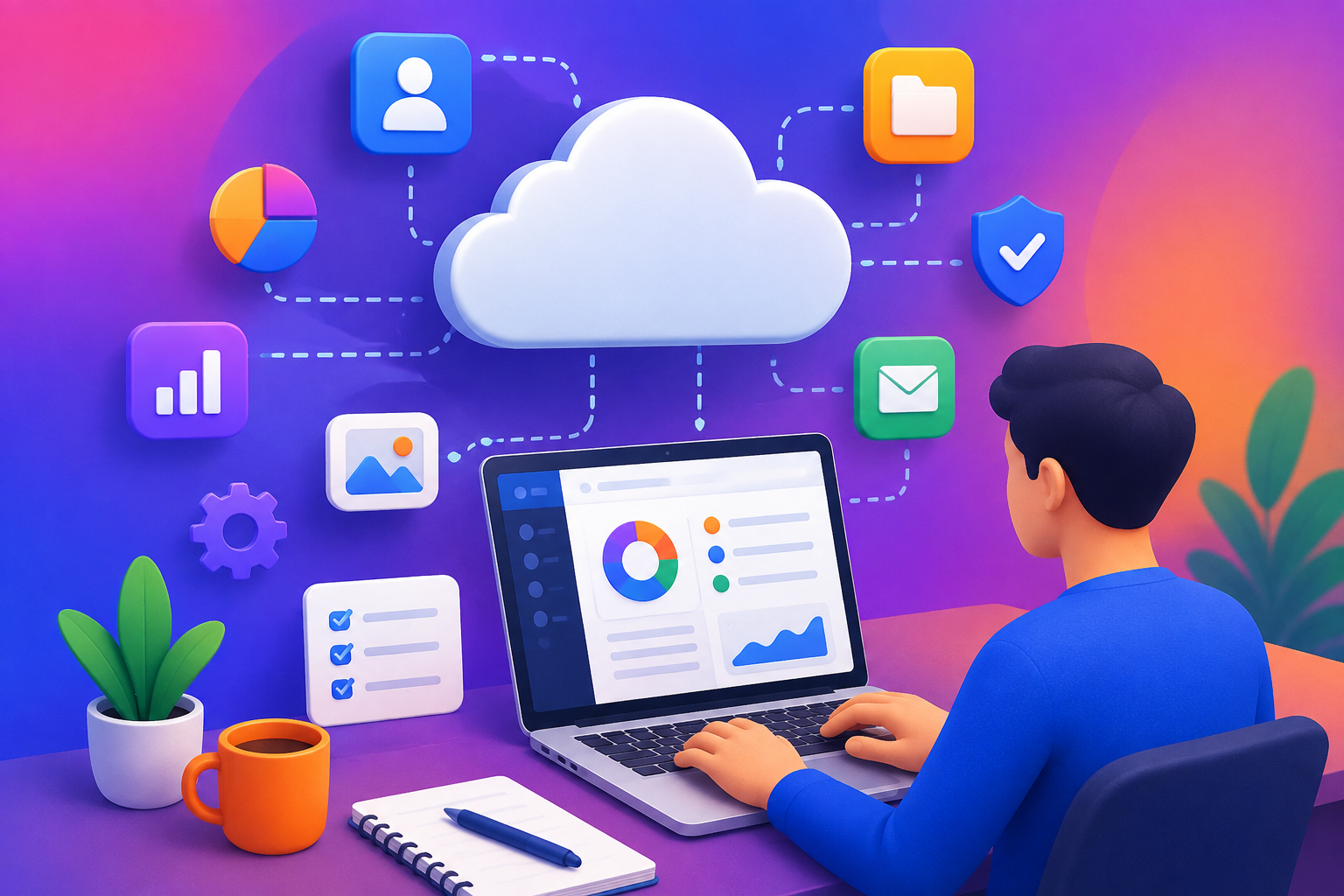
Software as a Service, commonly known as SaaS, allows businesses to access software through the internet without having to manage all of the underlying infrastructure themselves. Many SaaS platforms are designed to support organizations as their requirements change.
Scalability does not simply mean adding more users. It can involve increasing storage, handling additional transactions, supporting new locations, connecting more applications, and managing larger workloads.
For modern businesses, choosing technology that can grow alongside the organization can make expansion considerably easier.
What Is SaaS Scalability?
SaaS scalability refers to the ability of a SaaS application and its supporting infrastructure to accommodate increasing demands.
A business may need to scale because it has:
- More customers
- More employees
- More transactions
- More data
- More locations
- More products
- More website traffic
- More integrations
A scalable SaaS platform should be able to support these changes without requiring the company to completely replace its software infrastructure.
For example, a small company might initially need ten user accounts. As it expands, it may require 100 or 1,000 accounts.
A scalable SaaS platform should make this expansion manageable.
Why Scalability Matters
Business growth can happen quickly.
A company might launch a successful product, enter a new market, acquire another business, or experience a sudden increase in demand.
If its software cannot handle the increased workload, growth can create operational problems.
Employees may experience slower systems, data may become harder to manage, and customers may receive slower service.
Scalable technology can help businesses prepare for these changes.
Instead of rebuilding the technology environment every time the company grows, organizations can expand their existing SaaS systems according to their requirements.
Scaling Users
One of the simplest examples of SaaS scalability is user management.
A startup might begin with a small team.
As new employees join, the company can add accounts and assign appropriate permissions.
This can be particularly useful for organizations with changing teams.
A company may also need to create temporary accounts for contractors or external partners.
Good user-management features can make it easier to handle these changes while maintaining control over access.
Scaling Data
Business data can grow rapidly.
Customer records, documents, transactions, emails, support tickets, marketing information, and analytics can all contribute to the amount of data an organization manages.
A SaaS platform should be able to accommodate increasing data requirements without becoming impractical.
However, businesses should still understand storage limits, pricing structures, retention policies, and export options before selecting a platform.
Unlimited growth should never be assumed simply because an application is cloud-based.
Scaling Business Operations
Growth often changes how a company works.
A small business may initially manage customers through a simple process involving a few employees.
As the company expands, it may introduce specialized sales, marketing, customer service, finance, and operations teams.
The SaaS platform needs to support these different workflows.
For example, a CRM system may need to support increasingly complex sales pipelines, customer segments, reporting structures, and permissions.
Scalability therefore involves more than technical capacity. It also involves whether the software can support increasingly sophisticated business processes.
Cloud Infrastructure and SaaS
Cloud infrastructure plays a major role in SaaS scalability.
SaaS providers generally operate applications using cloud infrastructure that can be expanded according to demand.
Depending on the provider’s architecture, computing resources, storage, databases, and networking capacity can be adjusted as requirements change.
This can be more flexible than purchasing and maintaining physical servers for every stage of business growth.
However, scalability depends on the SaaS provider’s architecture and service capabilities. Not every SaaS product scales in exactly the same way.
Flexible Pricing Models
SaaS businesses commonly offer subscription plans based on factors such as users, features, usage, storage, or other metrics.
This can allow customers to start with a smaller plan and upgrade as their requirements increase.
For a growing company, this can be more practical than making a large upfront software investment.
However, businesses should examine pricing carefully.
A platform that appears inexpensive at a small scale can become expensive when the organization adds hundreds of users or significantly increases usage.
Companies should therefore estimate future costs rather than evaluating a SaaS platform only on its initial subscription price.
SaaS and Remote Teams
Remote and hybrid work can increase the need for scalable cloud software.
Employees may work from different cities, countries, or offices.
Cloud-based SaaS applications can provide a shared environment where authorized users can access the same information from different locations.
As a company hires more remote employees, it can often add users without building new physical software infrastructure for each location.
This can simplify expansion.
Security and access controls remain essential, especially when employees are working from different networks and devices.
Integrations and Scalability
As businesses grow, they often use more software.
A company may connect its CRM with its marketing platform, accounting software, customer support system, communication tools, and analytics applications.
These integrations can improve productivity by allowing information to move between systems.
However, a growing number of integrations can also create complexity.
Businesses should choose SaaS platforms that offer reliable integration capabilities and appropriate access controls.
They should also regularly review connected applications and remove integrations that are no longer necessary.
Automation Supports Growth
Growth often means more repetitive work.
Without automation, employees may need to perform the same tasks repeatedly as customer numbers increase.
SaaS platforms can provide automation features that help businesses handle larger workloads.
For example, a growing company might automate:
- Customer onboarding
- Email notifications
- Lead assignment
- Invoice reminders
- Task creation
- Support ticket routing
- Employee notifications
- Reporting
Automation can help organizations increase their operational capacity without increasing administrative work at exactly the same rate.
Scaling Customer Support
More customers usually mean more support requests.
A business that provides excellent support to 100 customers may struggle to maintain the same standard with 10,000 customers unless its processes evolve.
SaaS customer-support platforms can help businesses organize tickets, categorize requests, assign conversations, and track response times.
Knowledge bases and automated responses can also help customers solve simple problems without waiting for an employee.
However, automation should complement human support rather than making it unnecessarily difficult for customers to reach a person.
Analytics at Scale
As a company grows, decision-making becomes more complex.
Managers need to understand what is happening across different products, teams, customer groups, and markets.
Scalable SaaS platforms can provide dashboards and reporting tools that help organizations monitor performance.
Useful metrics may include:
- Customer acquisition
- Revenue
- Conversion rates
- Customer retention
- Support response times
- Employee productivity
- Product usage
Analytics can help leaders identify trends and determine where additional resources are needed.
Security During Growth
Growth can create new security challenges.
More users, devices, applications, integrations, and locations mean a larger environment to manage.
Businesses should therefore ensure that security processes scale along with operations.
Important practices include:
- Multi-factor authentication
- Role-based access
- Regular permission reviews
- Employee onboarding and offboarding
- Security monitoring
- Data encryption
- Secure integrations
- Backup and recovery planning
A company should not wait until it becomes large to establish good security practices.
SaaS Scalability and Reliability
Scaling is not only about handling more users.
A SaaS application also needs to remain reliable as usage increases.
Businesses should investigate the provider’s approach to availability, maintenance, incident response, and disaster recovery.
Service-level agreements may provide additional information about availability commitments.
Organizations should also understand what happens if the provider experiences an outage.
For critical business processes, having contingency procedures can reduce the impact of service interruptions.
Choosing a SaaS Platform for Future Growth
Businesses should think beyond their current requirements when selecting SaaS software.
Some useful questions include:
Can the platform support additional users?
Consider how easily accounts can be added and managed.
Can it handle increasing data?
Review storage and usage policies.
Does pricing remain practical at larger scales?
Estimate future costs.
Can it integrate with other systems?
Check available integrations and APIs.
Does it support automation?
Automation can become increasingly valuable as workloads increase.
Can permissions be managed effectively?
Growing organizations need more sophisticated access controls.
Can the platform support international expansion?
Businesses entering new markets may need additional languages, currencies, regions, or compliance capabilities.
Avoiding Vendor Lock-In
Scalability should also include the ability to change direction.
A business can become heavily dependent on a SaaS provider if all of its data and processes remain inside one platform.
Before committing to a service, organizations should understand:
- How data can be exported
- What formats are available
- Whether APIs are provided
- How integrations work
- What happens when the subscription ends
- How long data is retained after cancellation
Having a clear exit strategy can reduce long-term technology risk.
SaaS Scalability for Startups
Startups often face unpredictable growth.
A product may initially have a small user base and then suddenly attract significant attention.
SaaS platforms can provide startups with access to business software without requiring large investments in physical infrastructure.
A startup can begin with a relatively small technology environment and expand as demand increases.
However, startups should avoid selecting software based solely on immediate affordability.
The cheapest option may not always be the most cost-effective choice over several years.
The Role of Artificial Intelligence
Artificial intelligence is increasingly being incorporated into SaaS platforms.
AI can help businesses automate repetitive processes, analyze information, summarize documents, assist customer service, and generate insights.
For growing companies, these capabilities may help employees handle larger workloads.
For example, an AI-assisted customer service system might summarize customer conversations for support representatives.
A sales platform could analyze customer activity and suggest potential follow-up actions.
As with any AI system, businesses should evaluate accuracy, privacy, security, and human oversight requirements.
Common SaaS Scalability Mistakes
Businesses can make several mistakes when planning for growth.
One is choosing software based entirely on current needs.
Another is ignoring future pricing.
A company may select a platform that is affordable for five users but becomes prohibitively expensive after rapid expansion.
Businesses can also overlook data portability.
If moving information to another platform becomes extremely difficult, changing providers later can be expensive.
Finally, organizations sometimes scale their software without scaling their processes.
Adding more users to a poorly designed workflow does not necessarily improve productivity.
Technology and business processes need to evolve together.
A Practical SaaS Growth Strategy
Businesses can take a structured approach to SaaS scalability.
Start by identifying current bottlenecks.
Then estimate how the business may change over the next few years.
Evaluate software based on:
Capacity → Cost → Integrations → Automation → Security → Reliability → Data Portability
Testing a platform with a small team before a full deployment can also reveal potential problems.
Businesses should periodically review their SaaS environment as they grow.
Some tools may become unnecessary, while others may need to be upgraded or replaced.
Final Thoughts
SaaS scalability is an important consideration for businesses that expect to grow.
Cloud-based software can make it easier to add users, manage increasing workloads, automate processes, support remote teams, and connect different parts of an organization.
But scalability should not be judged solely by whether a platform can handle more users.
Businesses also need to consider pricing, security, integrations, reliability, data management, automation, and the ability to adapt as requirements change.
The best SaaS strategy is one that supports today’s needs while leaving room for tomorrow’s growth.
When businesses choose flexible technology and continuously improve their processes, growth becomes easier to manage. Instead of allowing technology to become a barrier, SaaS can become an important foundation for building a more adaptable and efficient organization.