Introduction
Artificial intelligence is expanding beyond chatbots, content generation, and automated business processes into a technology that can help people understand and manage complex real-world systems. One particularly promising development is the combination of AI with digital twins. This technology allows organizations to create virtual representations of physical objects, buildings, machines, factories, and even entire cities.
A digital twin is more than a three-dimensional model or a digital copy of a physical object. It can receive information from sensors, reflect changing conditions, and help users understand how a real-world system behaves. When artificial intelligence is added, the digital twin can analyze incoming data, identify unusual patterns, predict potential problems, and evaluate possible improvements.
For example, a manufacturer could use an AI-powered digital twin to understand why a machine is consuming excessive energy. A hospital might simulate patient movement to improve operational planning, while a city administration could model traffic conditions to explore ways to reduce congestion.
As businesses increasingly depend on data-driven decisions, AI-powered digital twins are becoming an important area of technological development. This article explores how the technology works, where it is being used, its major benefits, its limitations, and what the future may hold.
What Is a Digital Twin?
A digital twin is a virtual representation of a real-world object, process, or system that uses data to reflect its condition and behavior.
Traditional digital models are often created for visualization, design, or simulation. A digital twin can go further by maintaining a connection with the physical system it represents. Depending on its design, it may receive continuous updates from sensors, operational databases, connected devices, and other information sources.
Consider a wind turbine operating in a remote location. The physical turbine contains components that experience changing temperatures, vibration, wind pressure, and mechanical stress. Sensors can collect information about these conditions and transmit it to a digital representation.
Engineers can then use the digital twin to examine performance, identify abnormal behavior, and investigate maintenance requirements without physically inspecting every component.
However, a digital twin does not automatically understand everything happening in the real world. Its usefulness depends on the quality of its data, the accuracy of its underlying model, and how frequently the representation is updated.
When artificial intelligence is introduced, the system gains additional analytical capabilities.
How Artificial Intelligence Improves Digital Twins
Artificial intelligence helps digital twins interpret information and identify relationships that may be difficult to detect through traditional monitoring methods.
Several AI techniques contribute to these capabilities.
1. Machine Learning for Pattern Recognition
Machine learning systems can analyze historical and real-time information to identify patterns in equipment performance, energy consumption, production rates, and environmental conditions.
For example, an industrial machine may gradually develop unusual vibration patterns before a mechanical failure occurs. A machine learning model trained on relevant historical data could recognize similar changes and alert maintenance teams.
The warning is not guaranteed to be correct, but it can give technicians additional information for deciding whether an inspection is necessary.
2. Predictive Analytics
Predictive analytics uses available data to estimate what may happen under particular conditions.
An AI-powered digital twin might estimate how a building’s electricity consumption will change during a heatwave. A logistics company could model how different delivery schedules might affect fuel usage and arrival times.
These predictions help organizations prepare for possible outcomes rather than relying exclusively on historical reports.
Their reliability depends on whether the underlying data represents the conditions being predicted.
3. Simulation and Scenario Testing
One of the most valuable capabilities of a digital twin is the ability to examine hypothetical situations.
Organizations can use AI to explore questions such as:
- What happens if a production line operates at a higher speed?
- How would a building perform with different heating and cooling settings?
- What happens to traffic if a major road is temporarily closed?
- Which maintenance schedule could reduce equipment downtime?
- How would a distribution network respond to a sudden increase in demand?
AI can help evaluate different scenarios and identify promising alternatives. Engineers and decision-makers can then examine the results before implementing changes in the physical environment.
4. Automated Anomaly Detection
Anomaly detection identifies behavior that differs significantly from expected operating conditions.
For example, an AI system monitoring a commercial building might identify an air-conditioning unit that consumes more electricity than expected despite operating under similar environmental conditions.
The digital twin can provide additional context, helping facility managers investigate whether the cause could involve faulty equipment, incorrect settings, changing occupancy, or another factor.
An unusual measurement does not automatically mean that a component is failing. The purpose of anomaly detection is to highlight situations that deserve further examination.
Major Applications of AI-Powered Digital Twins
The combination of artificial intelligence and digital twins has applications across numerous industries. Its value is particularly clear in environments where physical systems are expensive, complicated, or difficult to monitor continuously.
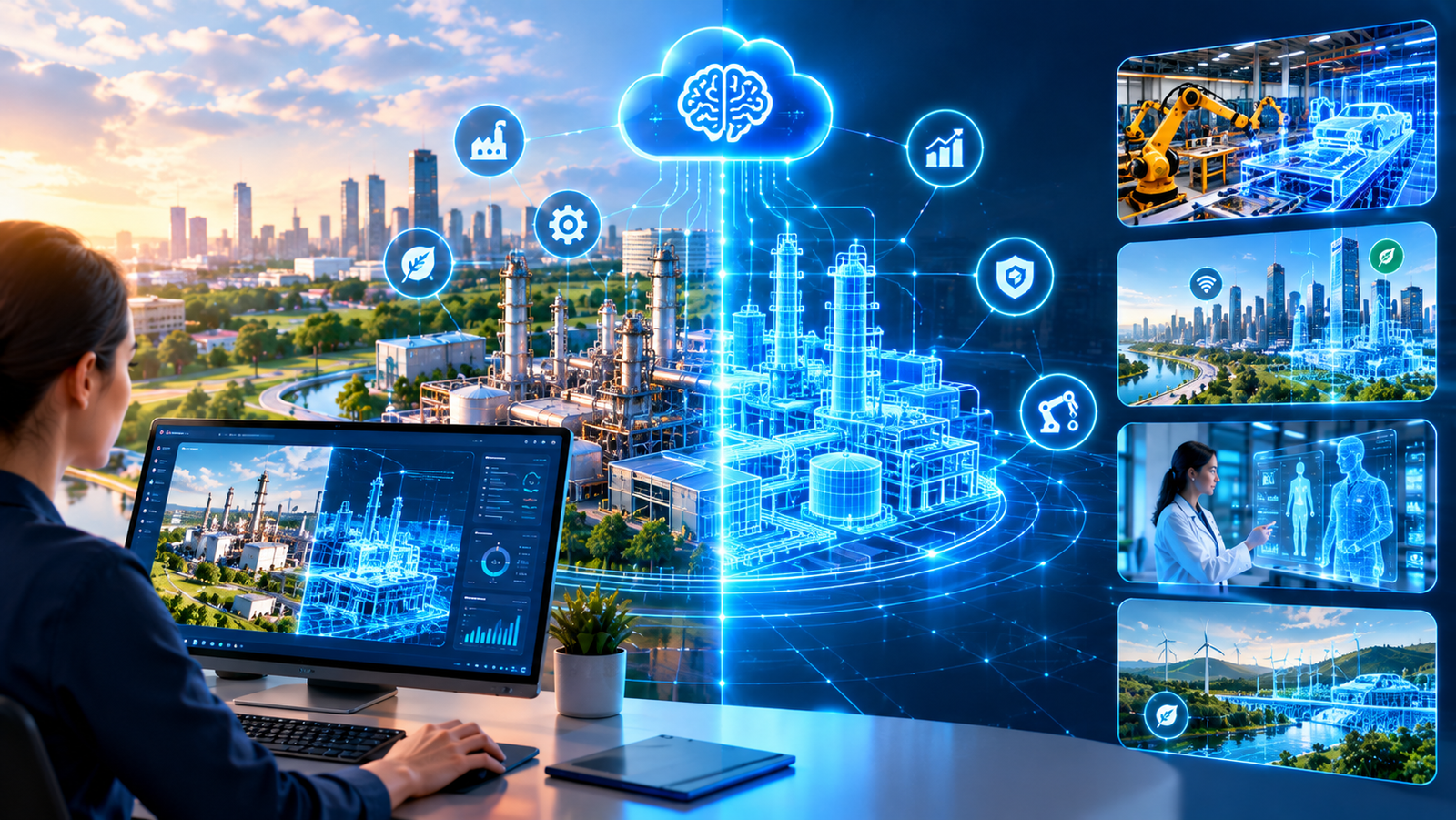
1. Smart Manufacturing and Industrial Operations
Manufacturing is one of the most promising areas for AI-powered digital twins.
Factories contain interconnected machines, production lines, robotic equipment, quality-control systems, and supply processes. A problem in one area can affect the performance of the entire facility.
A digital twin can represent individual machines or an entire production process. By combining operational data with AI models, manufacturers can better understand production performance and identify opportunities for improvement.
For instance, a factory producing electronic components could use a digital twin to examine how temperature, machine speed, material quality, and maintenance schedules influence manufacturing defects.
The system could help engineers compare different operating conditions and investigate potential causes of quality problems.
Additional applications include production scheduling, equipment monitoring, energy management, and workflow optimization.
Nevertheless, successful implementation requires reliable data collection and cooperation between operational teams, engineers, and information technology specialists.
2. Healthcare and Medical Research
Healthcare professionals and researchers are exploring digital twins as tools for understanding medical equipment, hospital operations, and biological systems.
At the hospital level, a digital twin could represent the movement of patients, the availability of beds, staffing arrangements, and the use of medical equipment.
An AI system could analyze different operational scenarios to help administrators identify bottlenecks and improve resource allocation.
For example, a hospital could simulate how changes in appointment scheduling affect waiting times across different departments.
In medical research, digital representations of biological processes may help researchers investigate disease mechanisms, study treatment hypotheses, or organize complex datasets.
Personalized digital representations of individual patients are also an area of research. In principle, such systems could combine medical records, imaging, laboratory measurements, and other information to support clinical analysis.
However, a comprehensive and clinically reliable digital twin of an individual human remains a difficult goal. Biological systems are highly complex, and predictions must be carefully validated.
AI-generated recommendations should not replace professional medical judgment or established clinical evidence.
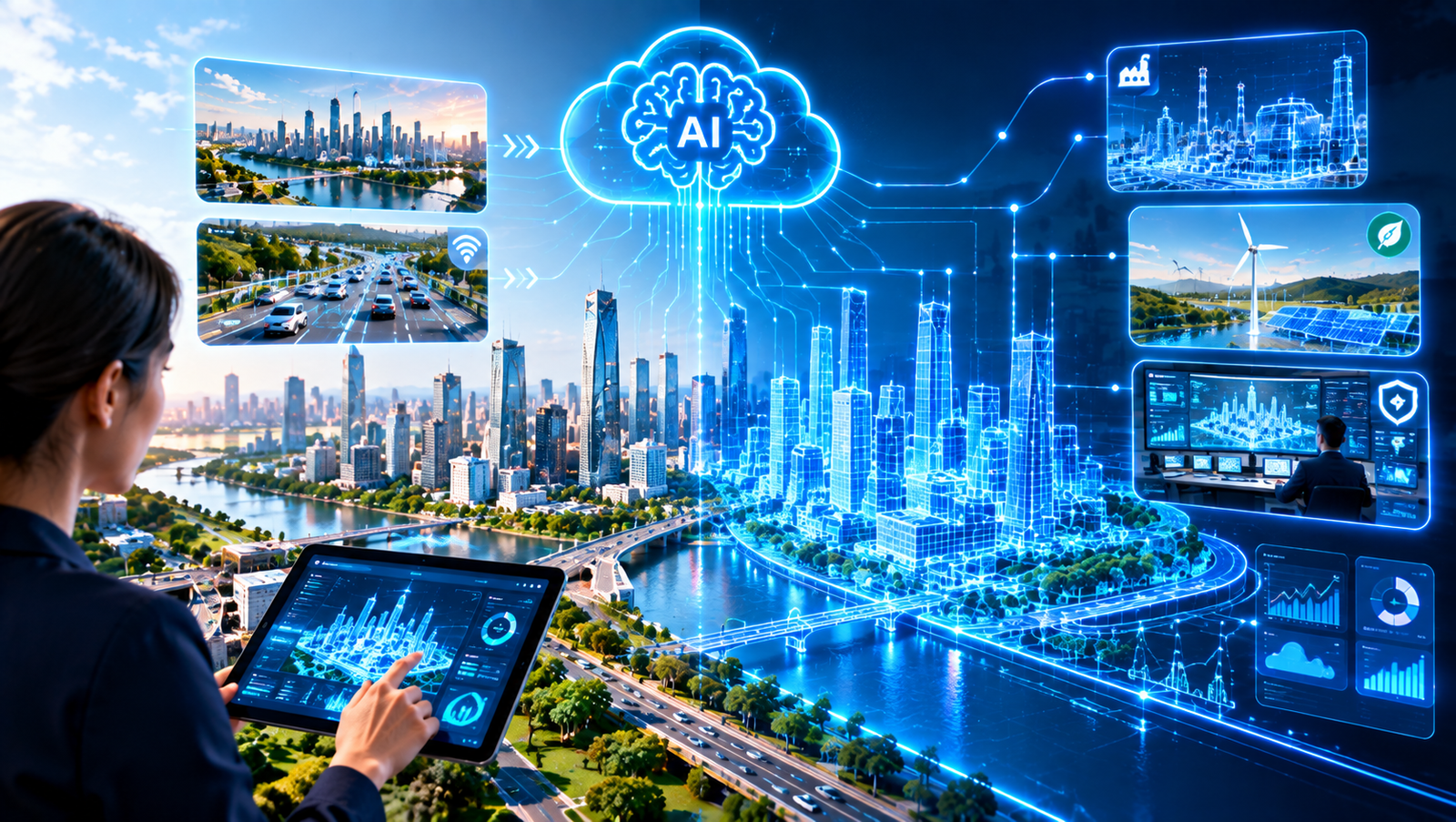
3. Smart Cities and Urban Planning
Cities depend on interconnected systems involving roads, public transportation, electricity, water, waste management, buildings, and public services.
AI-powered digital twins can help urban planners examine how these systems interact.
A city may create a digital representation of a road network and combine traffic information with weather conditions, public events, and transportation schedules.
AI models could then estimate where congestion is likely to increase and help planners evaluate potential interventions.
For example, officials might compare the effects of changing traffic-light timings, introducing a bus route, modifying a road intersection, or adjusting parking arrangements.
Digital twins can also support flood-risk analysis, infrastructure maintenance, building-energy assessments, and emergency planning.
These systems are only as useful as their data and assumptions. Inaccurate traffic measurements or incomplete infrastructure information can produce misleading results.
Cities must also consider privacy when collecting location information and monitoring public spaces.
4. Energy Production and Renewable Power
Energy infrastructure is another area where digital twins can provide substantial operational value.
Wind turbines, solar installations, power stations, batteries, and electricity distribution networks generate large quantities of technical data.
AI can analyze this information to help operators understand equipment performance and changing energy demand.
For example, a wind farm operator could use digital twins to investigate how wind conditions, temperature, vibration, and maintenance history affect turbine output.
In solar installations, performance analysis could help identify differences between expected and actual electricity generation.
Digital twins may also support battery monitoring by modeling temperature, charging patterns, energy capacity, and operating conditions.
At the grid level, virtual models can help engineers evaluate how changes in electricity demand or renewable energy production might affect system stability.
These applications are increasingly relevant as energy systems integrate more variable renewable sources.
However, electricity networks require rigorous engineering controls. AI predictions should be integrated into established safety procedures rather than treated as unquestionable instructions.
5. Aerospace and Aviation
Aircraft and spacecraft contain thousands of components that must operate reliably under demanding conditions.
Digital twins can help engineers monitor equipment, analyze performance, and investigate maintenance requirements.
For example, a digital twin of an aircraft engine could combine operating measurements with engineering models and maintenance records.
AI systems could examine how temperature, pressure, vibration, and operating hours relate to component wear.
This information may help maintenance teams prioritize inspections and investigate potential problems.
Digital twins can also support aircraft design, flight-system testing, and the evaluation of alternative engineering configurations.
In aerospace, the cost of failure can be extremely high. Consequently, AI-generated predictions must undergo extensive validation before being used in safety-critical decisions.
6. Construction and Building Management
Buildings are complex systems involving structural components, ventilation, lighting, elevators, security equipment, and energy infrastructure.
A digital twin can help building managers understand how these systems operate together.
When AI is integrated, the model can analyze energy usage, equipment performance, indoor environmental conditions, and occupancy patterns.
For example, an office building may consume substantial electricity outside normal working hours. An AI-powered digital twin could help facility managers investigate whether lighting, cooling, ventilation, or equipment schedules are contributing to the problem.
The system might also help evaluate changes to heating and cooling settings before they are applied throughout the building.
During construction, digital twins can connect design information with project progress and operational planning.
After a building becomes operational, the same digital representation may continue to support maintenance and renovation decisions.
The effectiveness of these applications depends on the availability of accurate building information and compatible monitoring systems.
The Role of Internet of Things Sensors
The Internet of Things, commonly called IoT, plays an important role in many digital twin implementations.
IoT devices can collect measurements from physical environments and transmit them to connected software platforms.
Depending on the application, sensors may measure:
- Temperature and humidity.
- Vibration and mechanical movement.
- Electricity consumption.
- Air quality and pressure.
- Equipment operating hours.
- Water flow and fluid levels.
- Location and environmental conditions.
These measurements help a digital twin reflect the current state of a physical system.
Artificial intelligence then analyzes the collected information to identify patterns, estimate future conditions, and support operational decisions.
Consider a cold-storage warehouse used to preserve food and pharmaceutical products. Temperature sensors can continuously monitor storage conditions. A digital twin can represent the warehouse’s cooling systems, storage areas, and equipment.
An AI model may identify unusual temperature fluctuations or estimate when cooling equipment requires inspection.
This combination can improve visibility into operations, although sensor failures, communication interruptions, and inaccurate measurements must still be addressed.
Not every digital twin requires continuous IoT connectivity. Some rely on scheduled updates, engineering simulations, operational records, or combinations of different data sources.
Benefits of Combining AI With Digital Twins
The advantages of AI-powered digital twins extend beyond visualization. When implemented appropriately, they can help organizations improve how they understand, test, and manage physical systems.
Reduced Maintenance Costs
Unexpected equipment failures can interrupt operations and require expensive repairs.
AI-powered monitoring can help identify warning signs and support maintenance planning. Organizations may be able to investigate potential problems before they develop into more serious failures.
The results depend on the accuracy of the models and the availability of meaningful operational data.
Better Operational Efficiency
Digital twins help organizations examine relationships between different parts of a system.
AI can identify potential inefficiencies in production, energy consumption, equipment scheduling, and resource allocation.
This information may help businesses reduce waste and improve the use of existing assets.
Safer Testing
Testing a major change directly in a physical environment can be expensive or dangerous.
Digital twins provide a way to investigate some possible outcomes through simulation before implementing a change.
For example, engineers can model alternative production-line arrangements without immediately rearranging expensive machinery.
A simulation cannot capture every real-world condition, but it can help identify problems earlier.
Improved Decision-Making
Traditional operational reports often describe what happened in the past.
AI-powered digital twins can combine historical information with current measurements and possible future scenarios.
This gives decision-makers additional evidence when comparing alternatives.
Rather than automatically accepting an AI recommendation, managers can use the model to understand the assumptions behind it and decide whether further investigation is necessary.
Greater Sustainability
Organizations can use digital twins to study energy consumption, material usage, equipment efficiency, and waste generation.
AI models may identify opportunities to reduce unnecessary resource consumption or compare the environmental effects of different operational strategies.
For example, a building operator could examine alternative cooling schedules to understand how they might influence electricity usage while maintaining acceptable indoor conditions.
The environmental benefit should be measured rather than assumed, particularly because developing and operating sophisticated computing systems also consumes energy and resources.
Challenges and Limitations of AI Digital Twins
Despite their potential, AI-powered digital twins are not simple plug-and-play solutions.
1. Data Quality Problems
AI systems depend on the information used to build and update their models.
Missing sensor measurements, inconsistent timestamps, incorrect equipment records, and unreliable historical information can undermine predictions.
Organizations need processes for checking, cleaning, and maintaining data before relying on the results.
2. High Implementation Costs
Developing a useful digital twin may require sensors, specialized software, cloud infrastructure, engineering expertise, system integration, and ongoing maintenance.
Complex industrial projects can involve substantial initial investment.
Smaller businesses may find it more practical to begin with a limited digital twin for one machine, building system, or operational process.
This approach can help demonstrate value before expanding the project.
3. Cybersecurity Risks
Connected digital twins may process sensitive business information and communicate with operational technology.
If these systems are poorly secured, attackers could gain access to confidential information or interfere with connected infrastructure.
Organizations should apply access controls, encryption where appropriate, network segmentation, secure software updates, monitoring, and incident-response procedures.
Particular care is necessary when a digital twin is connected to systems that control physical equipment.
4. Model Accuracy and Reliability
A digital twin is not a perfect copy of reality.
Its representation may become inaccurate when equipment changes, environmental conditions shift, or the underlying data no longer reflects actual operations.
AI models can also produce incorrect predictions when they encounter situations that differ substantially from their training data.
Regular validation against real-world measurements is therefore essential.
5. Integration With Existing Systems
Many organizations rely on older equipment, different software platforms, and inconsistent data formats.
Connecting these systems can be technically challenging.
Successful implementation often requires standardized data structures, compatible interfaces, careful testing, and coordination between engineering and IT teams.
6. Skills and Organizational Readiness
Digital twin projects may require knowledge of data engineering, AI, simulation, cybersecurity, and the physical systems being modeled.
Organizations that lack these skills may struggle to maintain the technology after its initial deployment.
Training employees and establishing clear responsibilities can help address this challenge.
How Businesses Can Start Using AI-Powered Digital Twins
Organizations interested in digital twins should begin with a clearly defined operational problem rather than adopting the technology simply because it is innovative.
Step 1: Identify a Specific Goal
Choose a measurable problem, such as excessive equipment downtime, high energy consumption, inconsistent production quality, or inefficient building operations.
Step 2: Select the Right System to Model
Start with a machine, process, facility, or other system for which useful data is available.
A focused project is generally easier to evaluate than a digital twin covering an entire organization.
Step 3: Review Existing Data
Determine whether the organization already collects relevant information through sensors, databases, maintenance systems, or operational software.
Identify missing measurements and establish how data quality will be maintained.
Step 4: Build and Validate the Digital Model
Develop a representation of the selected system and compare its behavior with real-world measurements.
The model should be tested under different conditions to understand its strengths and limitations.
Step 5: Introduce AI Capabilities
Depending on the objective, introduce machine learning, anomaly detection, predictive analytics, or optimization techniques.
Not every digital twin needs advanced AI. In some cases, simpler monitoring and simulation may provide sufficient value.
Step 6: Measure Results
Evaluate whether the project achieves its intended outcomes.
Useful measurements may include equipment downtime, maintenance expenditure, energy consumption, production quality, and response times.
Step 7: Expand Carefully
If the initial project demonstrates measurable benefits, consider applying the approach to additional machines, processes, or facilities.
Expansion should account for security, maintenance requirements, and the cost of keeping models accurate.
The Future of AI-Powered Digital Twins
Digital twins are likely to become more sophisticated as AI models, sensors, simulation software, and computing infrastructure continue to develop.
One potential direction is the integration of generative AI with digital twin platforms. Instead of navigating complex dashboards alone, engineers may be able to ask questions in natural language, such as why a machine’s energy consumption has increased or which operating conditions deserve further investigation.
The AI system could help summarize measurements, explain potential causes, and identify relevant simulation results. Its conclusions would still need to be checked against engineering evidence.
Another development is the growing use of edge computing. By processing information closer to the physical equipment, some digital twin applications may reduce communication delays and limit the amount of raw data transmitted to centralized systems.
This could be valuable in factories, transportation networks, and remote industrial installations.
Advances in simulation may also make it easier to model more complicated systems involving interactions between machines, buildings, transportation, and energy infrastructure.
Interoperability will remain important. Digital twins developed by different vendors will need reliable ways to exchange information if organizations want to model interconnected systems.
At the same time, stronger cybersecurity, better data governance, and more transparent AI models will be necessary to support wider adoption.
The long-term opportunity is not simply to create more detailed virtual models. It is to develop systems that help people understand real-world conditions, test alternatives, and make better-informed decisions.
Conclusion
AI-powered digital twins represent an important development in the relationship between artificial intelligence and the physical world. By combining virtual representations, real-time or periodically updated data, simulation, and machine learning, organizations can gain new ways to monitor equipment, evaluate scenarios, and improve complex operations.
Manufacturing, healthcare administration, energy, aviation, construction, and urban planning all offer potential applications. However, the technology also presents challenges involving data quality, implementation costs, cybersecurity, model accuracy, and system integration.
Organizations should approach digital twins as practical engineering and decision-support tools rather than perfect digital copies of reality. Clear objectives, reliable data, regular validation, and human oversight are essential for achieving useful results.
As AI capabilities continue to develop, digital twins may become increasingly valuable for understanding systems that are difficult to observe or test directly. Their greatest contribution will be helping people make more informed decisions about the physical environments on which businesses and communities depend.