Healthcare is one of the most demanding fields for robotics because medical procedures often require exceptional precision, consistency, and careful handling. Robotics is increasingly being used to support doctors, nurses, therapists, pharmacists, laboratory workers, and hospital administrators.
Medical robots are not designed simply to replace healthcare professionals. In many cases, their purpose is to extend human capabilities, improve precision, automate repetitive activities, and reduce physical workloads.
From robotic-assisted surgery to rehabilitation devices and hospital delivery systems, robotics is creating new possibilities throughout the healthcare industry.
What Is Medical Robotics?
Medical robotics refers to robotic technologies designed to support healthcare-related tasks.
These systems can perform or assist with surgery, rehabilitation, diagnostics, logistics, medication management, and patient support.
Medical robots vary greatly in design. Some are large robotic surgical platforms controlled by surgeons. Others are compact mobile machines that transport supplies around hospitals.
Each system is developed for a particular medical or operational purpose.
Robotic-Assisted Surgery
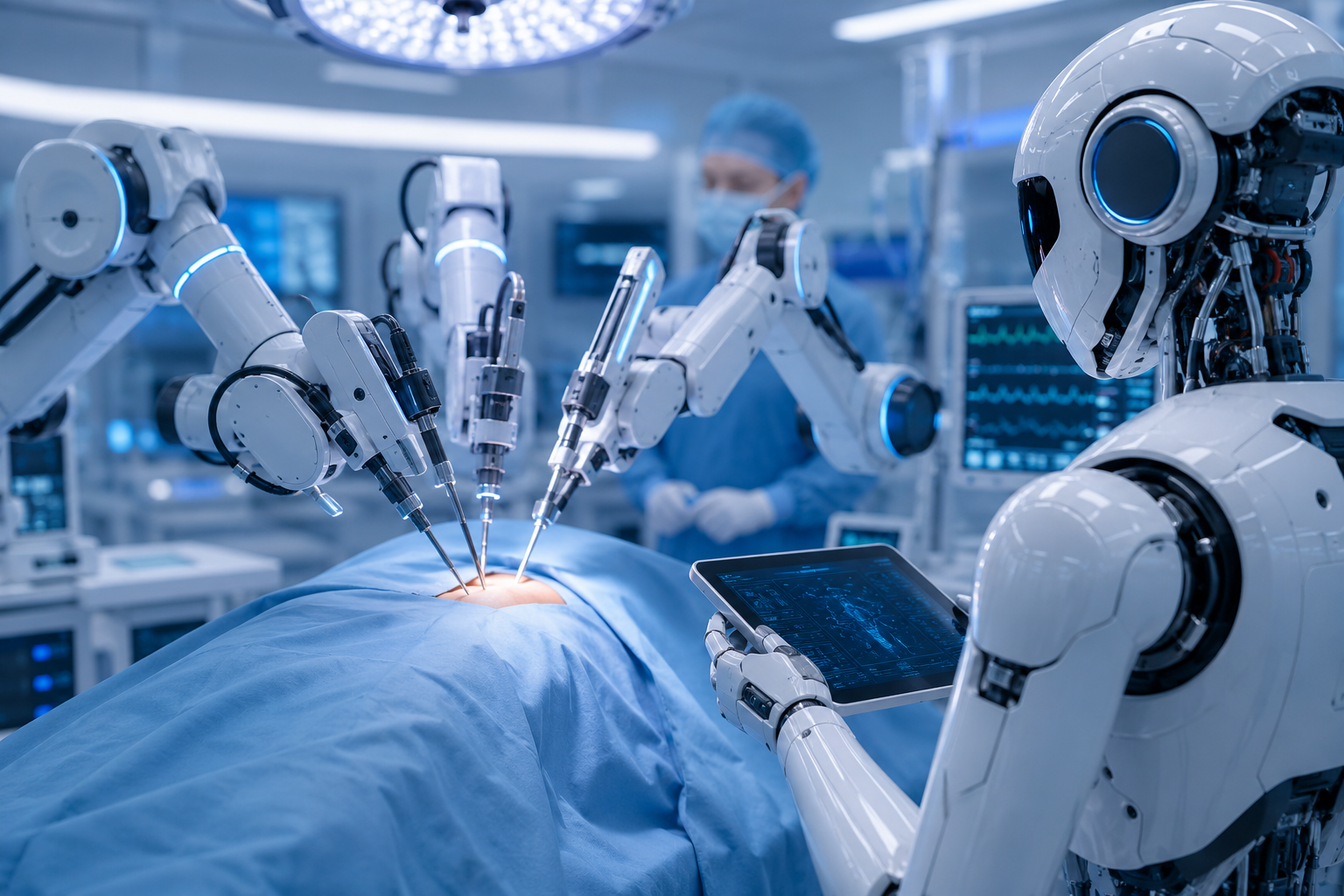
Robotic-assisted surgery is one of the most widely recognized applications of medical robotics.
A surgical robotic system typically allows a trained surgeon to control specialized instruments through a computer-assisted interface.
The robot can provide highly controlled instrument movement and may offer enhanced visualization depending on the system.
Robotic assistance can be particularly valuable for procedures requiring precise manipulation in small or difficult-to-access areas.
It is important to understand that surgical robots do not generally operate independently like fictional autonomous surgeons. Human medical professionals remain responsible for planning and controlling procedures in approved applications.
Precision and Stability
Human hands are highly capable, but they can experience natural limitations such as fatigue or small involuntary movements.
Robotic systems can translate a surgeon’s movements into carefully controlled instrument actions.
This can support precision during delicate procedures.
Robotics may also allow instruments to move in ways that are difficult to reproduce using traditional surgical tools.
The goal is not simply technological sophistication. The real objective is improving patient care, surgical control, and clinical outcomes when evidence supports the technology.
Rehabilitation Robotics
Robotics is also changing physical rehabilitation.
Patients recovering from injuries, neurological conditions, or surgeries may require repeated physical exercises.
Robotic rehabilitation systems can provide controlled and repeatable movement assistance.
For example, robotic exoskeletons or limb-assistance devices can support patients while they practice walking or moving affected limbs.
These systems can also collect data about movement, allowing therapists to monitor progress.
Robotics does not replace therapists. Instead, it can help therapists provide structured and measurable exercises.
Robotic Exoskeletons
Exoskeletons are wearable robotic systems designed to support or enhance movement.
A lower-body exoskeleton may assist with standing or walking, while other systems can support arm movements.
These technologies have potential applications in rehabilitation and mobility assistance.
However, practical deployment requires careful fitting, training, safety monitoring, and clinical assessment.
The technology must also be comfortable enough for patients to use for meaningful periods.
Robots in Hospitals
Hospitals contain extensive logistical operations.
Medicines, laboratory samples, linens, food, equipment, and other materials need to move between departments.
Autonomous mobile robots can assist with these transportation tasks.
A hospital robot may navigate corridors, use elevators where supported, avoid obstacles, and deliver supplies to designated locations.
Automating transportation can allow healthcare staff to spend more time on patient-facing responsibilities.
Pharmacy Automation
Medication management requires accuracy and organization.
Robotic pharmacy systems can automate certain storage, sorting, dispensing, or packaging activities.
These systems can reduce some repetitive manual work and help organize medication inventories.
However, medication safety remains dependent on appropriate software, procedures, verification, and human oversight.
Automation should therefore be considered part of a broader medication-management system rather than a substitute for professional responsibility.
Robots for Elderly Care
As populations age in many countries, healthcare systems face growing demand for elderly care.
Robotics could provide assistance with selected everyday tasks.
Care robots may potentially remind users about scheduled activities, provide communication assistance, transport objects, or support certain mobility tasks.
Social robots are also being explored for companionship and engagement.
However, emotional interaction raises important questions. A machine can provide assistance, but it should not automatically be treated as a replacement for human relationships and professional caregiving.
Robots and Telemedicine
Telepresence robots can allow healthcare professionals to communicate with patients or colleagues remotely.
A mobile telepresence system may include a screen, camera, microphone, and speakers.
A remote clinician can interact with people while controlling the robot’s position within a permitted environment.
This could be useful when specialists need to communicate with patients or staff in locations where physical travel is difficult.
Laboratory and Diagnostic Robotics
Laboratories often perform repetitive procedures involving samples.
Robotic automation can help with sample handling, sorting, pipetting, testing workflows, and data collection.
Automated systems can process large numbers of samples consistently.
This may be particularly valuable in high-volume laboratories where repetitive manual tasks consume significant staff time.
Again, proper validation and human oversight remain essential because medical decisions can have serious consequences.
Benefits of Robotics in Healthcare
Robotics can provide several potential benefits.
First, it can improve consistency in repetitive tasks.
Second, it can reduce physical workloads for healthcare employees.
Third, robots can perform certain tasks in environments where exposure risks exist.
Fourth, automated systems can collect detailed operational data.
Fifth, robotic assistance can enable some procedures and rehabilitation activities that would otherwise be more difficult.
The value of each technology depends on its specific clinical application and supporting evidence.
Challenges and Ethical Questions
Healthcare robotics also creates challenges.
The cost of advanced medical robots can be substantial. Hospitals need to consider purchasing, maintenance, training, software, and infrastructure.
Cybersecurity is another concern because connected medical devices can potentially become targets for unauthorized access.
Privacy must also be protected when robots collect patient information, images, audio, or movement data.
Ethical questions are equally important. Patients should understand when robotic technologies are being used and what role they play in their care.
Human accountability must remain clear.
Training Healthcare Professionals
Successful robotics adoption requires skilled professionals.
Surgeons may require specialized training before using robotic systems. Nurses and technicians may need to understand operation and troubleshooting. Biomedical engineers can help maintain and integrate robotic equipment.
Healthcare institutions therefore need ongoing education rather than treating robotics as a simple equipment purchase.
The Future of Healthcare Robotics
Future medical robots may become more intelligent, compact, connected, and specialized.
AI could help robots interpret medical images, recognize objects, assist with navigation, or personalize rehabilitation exercises.
Soft robotics may create safer and more flexible systems for interacting with the human body.
Miniaturized robotic technologies could also expand minimally invasive procedures.
However, healthcare will require a higher level of reliability than many other industries. New robotic technologies must undergo appropriate testing, validation, regulation, and clinical evaluation.
Conclusion
Robotics is becoming an important part of modern healthcare. Surgical systems, rehabilitation robots, hospital transport machines, pharmacy automation, exoskeletons, telepresence platforms, and laboratory robots are demonstrating how machines can support healthcare professionals.
The most valuable role of robotics is not necessarily replacing people. It is helping medical teams perform demanding tasks with greater precision, consistency, efficiency, and safety.
As technology advances, the combination of robotics, AI, medical expertise, and responsible regulation could create powerful new tools for improving healthcare while keeping human judgment and patient needs at the center.